
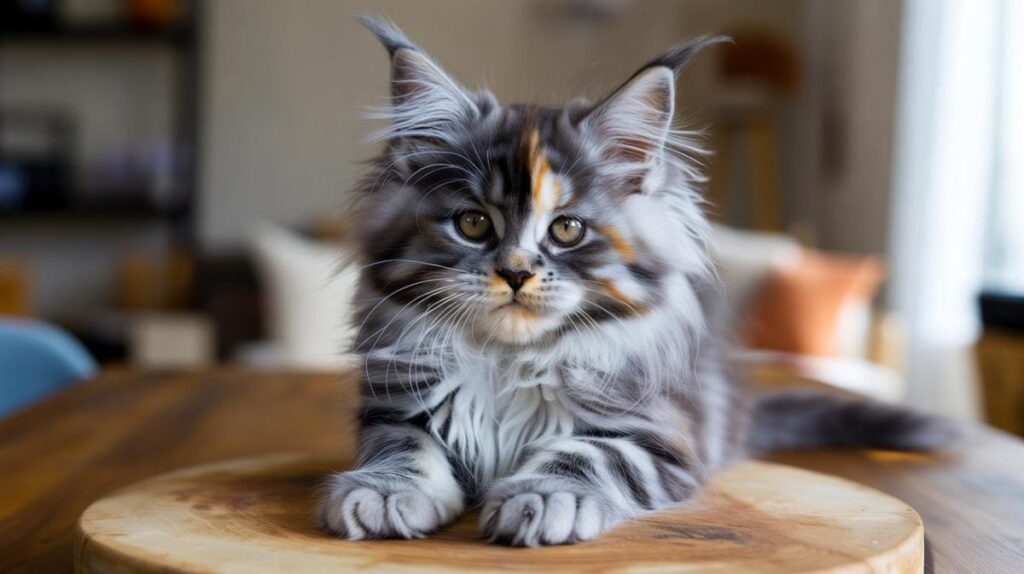
Photos of a rare “blue cheese” tortie Maine Coon named Lilac are circulating across social media, with viewers comparing her mottled coat to an artisanal cheese board and calling her one of the most unusual kittens they’ve ever seen.
A Maine Coon that looks like blue cheese
Lilac, bred by Nova’s Royal Pets, is a blue tortoiseshell Maine Coon kitten whose colouring makes her stand out even in a breed known for dramatic coats. She’s already large for her age, with a fluffy frame, long tail, and that unmistakable square Maine Coon muzzle.
What has really grabbed attention, though, is the mix of shades on her fur. Breeder Nova describes her as a “Blue Tri Maine Coon” – essentially a blue-based tortie with multiple tones.

Lilac’s coat blends blue-grey, cream and white in a way that genuinely resembles the crumbly texture of blue cheese.

From a distance, she reads as a cool, smoky blue. Close up, her face breaks into mottled patches and streaks that almost look hand-painted. That contrast has pushed her into viral territory, as clips and photos are shared across Instagram and TikTok.
What makes her coat so unusual
Breeders and enthusiasts are particularly struck by three features:
- Blue-grey fur spread across most of her body
- A bright white patch on her chest that pops against the darker tones
- A tortoiseshell mask on her face with scattered, “crumbly” patches of pale and dark
That facial pattern is where the “blue cheese” nickname really comes to life. The colour break is irregular, not a neat split or stripe, and that scattered visual texture reminds many people of cheese veining. She is also still a kitten, so her colouring is expected to deepen and shift slightly as she grows, which often makes tortie patterns look richer with age.
No, Lilac isn’t actually a lilac Maine Coon
Her name has led to some confusion. In pedigree cat language, “lilac” refers to a specific soft, pinkish-grey shade. There are lilac Maine Coons, and they are considered rare and sought after.
Lilac the cat is not a lilac-coloured Maine Coon; she’s a blue tortie whose name simply follows a floral theme.
Her litter was named after flowers, so Lilac ended up with a botanical name rather than a colour label. One of her sisters is reportedly called Lavender and is developing into an equally striking young cat, though with a different coat pattern.
This kind of naming confusion is common in pedigree cats. Pet names often overlap with formal colour terms, leading to assumptions that a cat’s name signals its rarity or pedigree status, when it may just be something the breeder liked the sound of.
European lines and that “wild” look
Lilac comes from European Maine Coon lines, a style many fans associate with a slightly more rugged appearance. These cats often have:
- Larger, heavier frames
- Pronounced ear tufts and lynx-like tips
- Stronger muzzle and jaw shape
- Thicker, shaggier coats
That combination tends to exaggerate any unusual coat pattern. On a big, heavily furred body, colours seem bolder, and facial markings stand out in photos. It helps explain why Lilac’s marbling seems so dramatic, even compared with other torties.
Why tortie and patterned Maine Coons are in demand
Maine Coons come in a wide range of colours, from classic brown tabby to solid black, cream, and red. Among breeders and collectors, patterned coats are often the most coveted.
In this breed, rarity usually means complexity: layers of colour, unusual distribution, or an effect that changes as the cat moves.
Some of the most sought-after looks include:
 A €700,000 treasure: a Rhône resident finds gold bars and coins while digging a swimming pool
- Tortie Maine Coons – patchworks of two or more colours, usually on a black or blue base
- Calico Maine Coons – tricolour cats with clear white areas alongside red and black or blue
- Smoke Maine Coons – cats whose hair shafts are pale at the root and dark at the tip
Smoke coats, in particular, create a dramatic effect when the fur parts around the neck and face, almost like a moving spotlight. As the cat walks or turns its head, light reveals flashes of silver or white under the darker top layer.
| Coat term | What it means |
|---|---|
| Blue | A cool steel-grey shade, not actually blue |
| Tortie (tortoiseshell) | Mixed patches of two or more colours, typically black/blue with red/cream |
| Smoke | Pale roots with darker tips, giving a smoky shimmer |
| Lilac | Pale, warm grey with a faint pinkish tone |
Solid colours like gold, blue, and true lilac also attract attention, but patterned cats often create that viral “wow” moment when a new photo surfaces.
Why rare cats go viral so fast
Lilac’s rise from breeder’s kitten to internet talking point fits a clear social pattern. Unusual animals, particularly those with highly photogenic features, spread quickly because they stand out against an endless scroll of similar content.
People share these images not just because the animals are pretty, but because they feel like they have spotted something special. When a cat looks like blue cheese, that novelty sticks in the mind and sparks discussion in comment sections and group chats.
Rarity, a memorable nickname, and a single striking feature are often all it takes to create a viral pet moment.
Breeders used to rely mainly on shows and specialist magazines. Now, accounts posting short clips of kittens like Lilac can build waiting lists and brand recognition almost overnight.
Thinking of looking for a “rare” Maine Coon?
Stories like Lilac’s often trigger a rush of interest. Before anyone starts hunting for their own “blue cheese” kitten, there are a few points worth remembering:
- Unusual colours can come with higher price tags
- Reputable breeders will prioritise health and temperament over novelty
- Coat colour alone does not guarantee a cat’s personality or compatibility with a home
Maine Coons in general tend to be friendly, people-oriented, and playful well into adulthood. They are also big, strong cats that can weigh as much as a small dog. Prospective owners need space, sturdy scratching posts, and a budget for quality food and regular veterinary care.
Understanding coat genetics without a textbook
The science behind Lilac’s look sits in feline genetics, but you do not need a degree to grasp the basics. In simple terms, a few key genes control:
- Whether a cat is black-based or red-based
- Whether that base is diluted to blue or cream
- How pigment is distributed along each hair
- Whether white patches appear and where they land
Tortie and calico cats carry both black-based and red-based colour genes, which mix on the coat. Dilution genes then soften those colours to blue and cream. In smoke cats, pigment is limited to the tips of the hair, leaving pale roots. When you stack these effects together, you get the striking, blended look that people compare to cheese veining or marble.
Most torties are female, due to how colour genes sit on the X chromosome. That makes a big, blue tortie Maine Coon like Lilac almost certainly a queen, adding to her potential value for future breeding programmes focused on rare patterns.
Why this “blue cheese” kitten matters beyond the meme
Viral pets can sometimes shape demand in ways that affect real animals. When a look becomes fashionable, less responsible breeders may focus on chasing those colours at the expense of health testing or appropriate socialisation.
Anyone enchanted by Lilac’s photos can enjoy the spectacle while also asking careful questions if they decide to approach a breeder: which health screenings are done, what temperament the parents have, and how kittens are raised before they go to new homes. A stable, confident Maine Coon with a standard coat will generally be a more rewarding companion than a nervous cat with a rare pattern.

For people not ready to commit to a giant pedigree cat, there is another option: local shelters and rescue groups are full of cats with fascinating, one-off markings that never make it to social media feeds. They might not look like blue cheese, but the same basic appeal is there – a face that feels utterly individual, and a personality that makes them unforgettable once you meet them.
 Forget the French bob, this bob haircut will be the trendiest in 2026 according to experts
