
The day my favorite loafers betrayed me, I was standing in the supermarket aisle, staring at the tins of tomatoes. My right foot was burning, my left little toe felt like it was stuck in a door, and the shoes I’d worn for ten years suddenly felt like torture devices. I hadn’t gained weight. I hadn’t run a marathon. I had simply turned 60 a few months before.
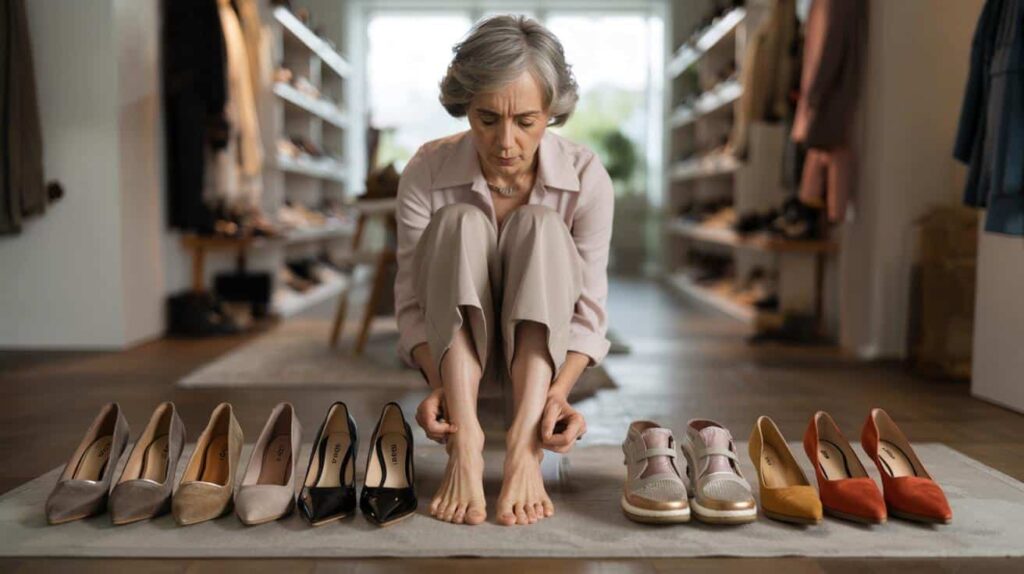
I went home barefoot, shoes in hand, like a kid who had lost a bet.
That night I lined up all my shoes in the hallway. Pumps for weddings, walking sandals, trainers, winter boots. Half of them I could no longer slide into without wincing. Something had shifted. Not in the shoes. In me.

And nobody had warned me that past 60, **feet stop adapting to shoes**. It’s the shoes that must adapt now.

When your feet quietly change shape after 60
The strange thing is that this change doesn’t happen with drama. There’s no clear day-one, day-two. It’s more like one morning, your trusty sneakers feel “a bit tight”, and a year later, you’re peeling off your socks at 4 p.m. because your toes are begging for mercy.
You tell yourself the leather probably shrank, or that brand has changed its sizing. You blame summer heat, socks, walking too much. Anything but the obvious: your foot is no longer the same foot you had at 45.
Bones spread. Arches sink a little. The fat pads under the heel thin out. The foot flattens and widens, almost invisibly, until the shoes you adapted to for decades suddenly feel like they’re punishing you for aging.
I met a retired school principal, 68, who had always prided herself on her elegant, narrow size 37 shoes. She told me about the day she went to buy a new pair “for comfort” and left the shop with wide-fit size 39s. She cried in the car, more from shock than vanity.
Her story repeats itself everywhere. A Paris podiatry clinic reported that more than half of their new patients over 60 arrive wearing shoes at least one size too small. Not because they love suffering. Because they’re still buying “their” size from ten or twenty years earlier.
Feet can lengthen by up to half a size and widen by a full size after 60. No one puts that on birthday cards.
This change is structural, not just “I walked too much yesterday”. Collagen loses elasticity. Ligaments loosen. The arch that once held everything tight slowly relaxes and spreads. If you’ve had pregnancies, heavy work standing up, or years of cheap shoes, it often happens faster.
The body, very calmly, reorganizes itself. The problem is that our wardrobe and our identity don’t follow. We keep old reference points: “I’ve always been a size 38”, “I’m not the wide-fit type”. So we squeeze a new foot into an old idea.
The real shift is this: before 60, the foot tends to mold itself, tolerating a bit of pressure. After 60, the tolerance drops. What used to be “a bit tight but fine” turns into corn, bunion, or knee pain three months later. The bill arrives late, but it arrives.

Learning to dress the feet you actually have now
The first practical gesture is almost childlike: measure your feet again. Both of them. Standing up, at the end of the day, when they’re slightly more swollen. Use a ruler or a sheet of paper against the wall, trace the outline, and measure length and width.
Then, do the forbidden thing: ignore the number engraved in your memory. Look at what the tape measure says today. That is your real starting point.
From there, think of trying shoes like trying glasses. You don’t argue with the optician when your eyesight changes. You accept the new correction. With shoes after 60, it’s the same story, but closer to the ground. *You’re not betraying your younger self by changing size. You’re caring for the body that carried you to this age.*
The most frequent mistake is stubbornness disguised as loyalty. We stay attached to a shape, a height, a brand, almost as if changing them would mean admitting “I’m getting old”. The heel that looked chic at 50 becomes a silent enemy at 65, but we keep it because it feels like part of our style.
There’s also the false idea that comfort equals “ugly shoes”. So we suffer in rigid loafers, narrow ballerinas, or pointed dress shoes for weddings, and then complain that walking is hard “at our age”. Let’s be honest: nobody really throws out uncomfortable shoes as soon as they hurt. We tell ourselves we’ll “break them in”.
Past 60, it’s not the foot’s job to break in the shoe anymore. It’s the shoe’s job to respect the foot’s new geography.
“After 60, the question isn’t ‘What size did I always wear?’ but ‘What do my feet look and feel like this year?’,” a podiatrist in Lyon told me. “The people who age best are the ones who accept to renegotiate their relationship with their shoes.”
- Choose soft, flexible uppers that give way to toes instead of trapping them.
- Look for a wider toe box so toes can spread, especially if bunions or deformities are starting.
- Keep a small heel (2–3 cm) instead of dead-flat soles to support the arch without tipping you forward.
- Test shoes at the end of the day and walk at least a few minutes in the store, not just two steps.
- Rotate pairs: one for long walks, one for home, one for events, so pressure points change regularly.
Living with changing feet without shrinking your life
Behind this story of shoes, there’s a quieter fear: the fear that if walking becomes painful, life will start to shrink. Outings become rarer. Markets, museums, city breaks feel “too tiring”. Little by little, the world gets smaller because each step costs more.
Accepting that your feet have changed isn’t just a practical detail. It’s a way of protecting your freedom of movement. Mobility is dignity, independence, spontaneity. A pair of shoes that fits badly is like a door that closes without warning. A good pair feels like someone has quietly propped that door open for a few more years.
 Goodbye kitchen cabinets: the cheaper new trend that won’t warp, swell, or go mouldy over time
The conversation we rarely have is this one: aging means updating our gear as often as our medical check-ups. Glasses, hearing aids, mattresses, and yes, shoes. Not to stay young. To stay moving.

| Key point | Detail | Value for the reader |
|---|---|---|
| Feet change shape after 60 | Arches relax, feet widen and sometimes lengthen | Helps explain sudden discomfort and ends self-blame |
| Old shoe size becomes unreliable | Measuring feet again and trying wider models | Reduces pain, blisters, and long-term joint problems |
| Shoes affect independence | Comfortable, adapted shoes support walking and balance | Protects mobility, social life, and daily autonomy |
FAQ:
- Do feet really keep growing after 60?They don’t “grow” like in adolescence, but they can lengthen and widen as ligaments loosen and arches collapse slightly. The bones spread, so the footprint gets bigger even if you haven’t gained weight.
- Should I throw away all my old shoes?No, start with the pairs that hurt within 30 minutes of walking. Keep those that still feel neutral or comfortable. You can also use insoles or heel grips in some older pairs to adapt them instead of replacing everything at once.
- Are wide-fit shoes always the solution?Not always. Some people need more depth rather than width, others need softer materials or lower heels. Wide-fit can help with bunions and toe crowding, but the overall shape and flexibility of the shoe matter just as much.
- How high can my heels be after 60?A small heel of 2–3 cm is often better than totally flat soles. Beyond 4–5 cm, pressure on the forefoot increases sharply and balance becomes trickier, so keep higher heels for very short periods only.
- When should I see a podiatrist?If you have persistent pain, new calluses, visible deformities like bunions, or if you’ve started avoiding walking because of your feet, a podiatrist visit can change your daily life. They can analyze your gait, advise on shoes, and prescribe custom insoles if needed.
