
On a grey Prague morning, the kind where the Vltava looks like brushed steel, a group of young analysts huddles in a café near Náměstí Republiky. Their screens glow with the same name: Czechoslovak Group. Between sips of burnt espresso, they speak the new language of European power – order backlogs, artillery shells, IPO valuation ranges. A company that once dealt in trucks and niche military kit is suddenly being whispered about as the next big thing in defence, right in the heart of Central Europe.
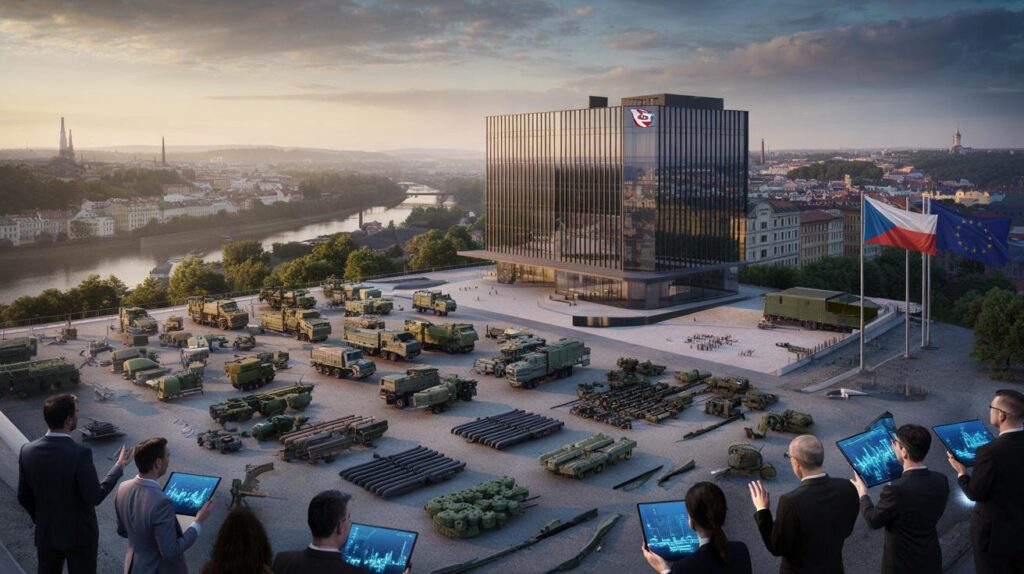
Outside, tourists pose in front of medieval façades, mostly unaware that a modern arms powerhouse is quietly taking shape a few tram stops away.
Something big is preparing to list on the stock market – and it’s not coming from Berlin or Paris.

A defence giant blooms in the “other” Europe
For years, when people talked about European defence, the default mental map stopped at Germany, France, maybe Italy. The Czech Republic rarely featured in that mental shortlist. Yet **Czechoslovak Group (CSG)** has used that blind spot almost like a stealth mode. While bigger Western champions were bogged down in politics and long procurement cycles, this family-owned group in Prague was busy snapping up factories, rebuilding old brands, and quietly filling warehouses with ammunition.

The war in Ukraine turned that low-profile strategy into a spotlight. European governments, suddenly short of basic shells and vehicles, started calling the Czechs. That’s when many outsiders realised: a serious new player had been hiding in plain sight.
Look at the numbers and the mini-story becomes hard to ignore. CSG has grown from a regional industrial group into a multi-billion-euro defence and industrial conglomerate spanning ammunition, ground vehicles, radars, and rail systems. It has acquired names like Italy’s Fiocchi in ammunition and some of the remnants of Western firms that slowed down after the post–Cold War peace dividend.
One Czech banker in Prague’s financial district describes the group’s trajectory with a shrug and a half-smile: “They bought what Western Europe thought it didn’t need anymore. Then 2022 happened.”
European defence spending surged, and suddenly those sleepy factories in Central Europe were strategic assets.
The IPO now being prepared could be the turning point. Listing on a major stock exchange would give CSG something it has never really had before: public-market firepower. That means fresh capital to modernise plants, ramp up production of artillery rounds, and invest in new tech such as smart munitions and electronic warfare.
It also gives Europe an alternative voice in a sector long dominated by German and French heavyweights. A listed Czech group big enough to sit at the same table as Rheinmetall, Thales, or Dassault changes the chemistry of European defence policy. Suddenly, Brussels and NATO don’t just look westward for industrial answers – they look east as well.
How a family group turns into a listed power broker
Behind the scenes, the upcoming IPO is being built step by step, not with fireworks but with method. Bankers and lawyers are combing through CSG’s business lines, segment by segment, shaping a story that public markets can understand: stable defence contracts, long-term government customers, and rising demand driven by a more dangerous world.
The group has been consolidating its identity, pulling disparate assets – ammunition, vehicles, rail, aerospace – under a clearer umbrella. Think of it as the difference between a cluttered workshop and a showroom. The activity is the same, but the presentation suddenly speaks to investors in London, Paris, and New York.
There’s also a cultural shift happening inside the company. For years, CSG could act like a classic Central European family business: fast decisions, tight inner circle, limited public disclosure. Preparing for a landmark IPO means inviting auditors into every corner, publishing figures that were once private, and accepting that fund managers will scrutinise every delay on a production line in Slovakia or Italy.

We’ve all been there, that moment when something that used to feel small and local suddenly has to stand on a bigger stage. For the employees in those factories, from Pardubice to Brno, the listing isn’t just about headlines. It’s about whether their once-quiet employer will become a publicly traded brand name front-page newspapers actually spell correctly.
Strategically, the timing is no accident. European capitals are pledging to raise defence spending towards or beyond 2% of GDP. Ammunition stockpiles are depleted. The United States looks less predictably committed to Europe than at any time in decades. That combination creates a structural demand story that investors can model on spreadsheets.
At the same time, being outside Germany and France gives CSG a different political posture. It is close to the front lines of NATO’s eastern flank, with governments like the Czech Republic and Poland arguing loudly for quicker rearmament. A Central European champion speaks the language of urgency that some Western capitals still struggle with. *For a lot of portfolio managers, that urgency now feels less like noise and more like the new baseline.*
The quiet risks, the loud opportunities
For all the upside, navigating a defence IPO in 2026 Europe is a delicate balancing act. One very concrete move CSG has been working on is to cleanly separate its purely civilian activities from core defence. That allows investors with ESG constraints to understand where their money is going, and governments to see clearly who controls what.
Think of it as drawing firm lines on a map: this side is rail and heavy trucks, that side is ammunition and systems. Only with those lines in place can a large pension fund from the Nordics, for instance, even sit down and have a conversation about buying shares.
One recurring trap for fast-growing defence players is overpromising on capacity. Orders pile up, factories run at night, politicians give bold speeches, and then a bottleneck appears – a missing component, a labour shortage, a permit stuck in a ministry drawer. Let’s be honest: nobody really does this every single day.
CSG will be under intense pressure to avoid that “hype-to-delay” cycle once it’s public. The markets are often unforgiving. A missed delivery to a NATO country doesn’t just dent a quarter’s earnings, it shakes confidence in the entire investment case. The group has to scale like a tech firm, but with the reliability standards of an arms supplier. That’s a tough mix, and they know it.
“CSG’s IPO is not just about raising money,” says a Prague-based defence analyst. “It’s a signal that Central Europe isn’t just a subcontractor anymore. It wants a seat at the table when Europe decides who builds what, and where.”
- Emerging European pole
A listed Czech defence champion offers a counterweight to traditional Franco-German dominance in procurement debates. - Frontline credibility
Proximity to Ukraine and NATO’s eastern flank means CSG’s products are shaped by real battlefield lessons, not only simulations. - Industrial resilience
By reviving legacy factories and brands, the group helps Europe rebuild stockpiles and industrial depth that were allowed to fade after the Cold War.
A new centre of gravity for Europe’s hard power
What happens if the IPO succeeds and CSG really does grow into one of Europe’s biggest listed defence groups? The map of influence starts to shift. Prague, Ostrava, Bratislava – these names begin to appear in briefings in Brussels where only Paris and Berlin once dominated the slides.

Small suppliers in the region suddenly find themselves plugged into a bigger ecosystem. Students at Czech technical universities eye careers not just at carmakers, but in advanced defence engineering. Politicians in Central Europe gain something they rarely had before: industrial leverage in conversations about joint EU programmes.

| Key point | Detail | Value for the reader |
|---|---|---|
| CSG’s landmark IPO | First major Central European defence group aiming for a large public listing | Signals a power shift in where Europe’s defence industrial core is located |
| Beyond Franco-German dominance | Czech-based player joining the top tier alongside traditional Western champions | Helps readers understand new political and industrial balances inside the EU |
| Market and security impact | Fresh capital to boost ammunition, vehicles, and high-tech systems capacity | Clarifies how this IPO connects to everyday issues like security, budgets, and jobs |
FAQ:
- Question 1What exactly is Czechoslovak Group and what does it produce?
- Question 2Why is this IPO considered a turning point for European defence?
- Question 3How is a Czech company competing with German and French defence giants?
- Question 4Is investing in a defence IPO compatible with ESG concerns?
- Question 5What could this mean for Europe’s security and for NATO in the next decade?
