
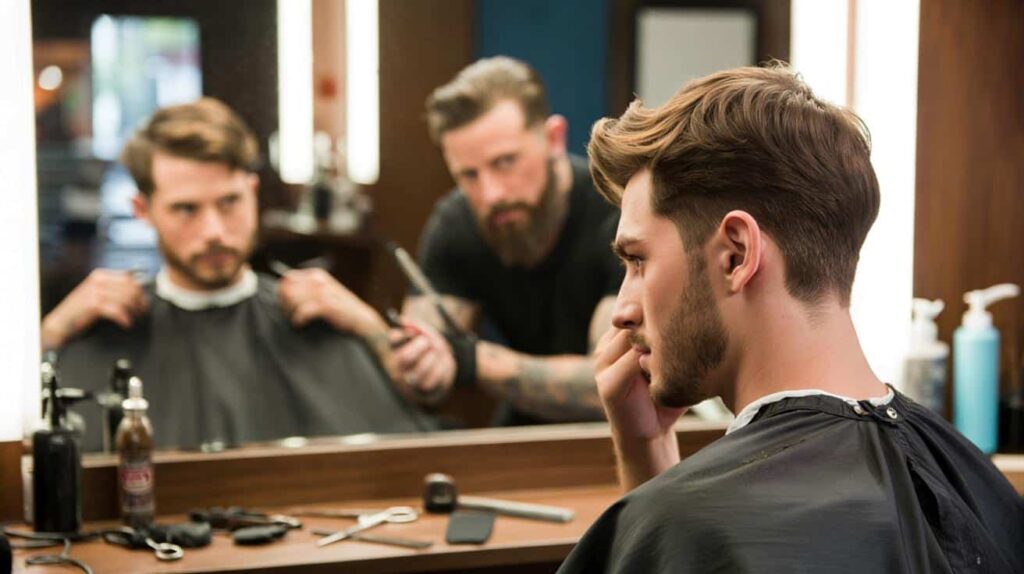
End of day at the barbershop. Hair on the floor, low music from a tired speaker, that hum of clippers that feels strangely comforting. A young guy in a faded hoodie stares at himself in the mirror, touching his brand‑new cut with a doubtful face. “I don’t know… it feels weird,” he mumbles. The barber smiles the way barbers do when they’ve seen this a thousand times. “Give it a week,” he says. “Your head will catch up.”
We’ve all been there, that moment when you walk out of the chair half-convinced you’ve made a mistake. Then ten days later, suddenly, the cut feels like it’s always been yours. You move your head and it just… follows. Your hands find their way into it as if they’ve known the path forever. Why do some cuts feel more natural with time instead of less?
Barbers insist it’s not magic. It’s design.

The “second-week magic” cut barbers quietly swear by
Ask barbers what cut ages the best and many will point to a very specific family of styles. Not the ultra-tight skin fade that looks razor-sharp for 48 hours. Not the hyper-styled quiff that collapses the moment it rains. The haircut that feels more natural over time is usually a mid-length, slightly textured cut that respects how your hair already wants to grow. Think soft fade around the sides, some length on top, barely-there transitions.

It doesn’t scream. It settles. At first day, it can even look almost too clean, too “done,” like a new pair of sneakers you’re afraid to crease. But by day five, a little growth, a little fluff, and suddenly it matches your face, your way of moving, the way you sleep.
One Paris barber described his regulars in almost the same words: “They walk out doubtful, they come back obsessed.” He told me about a client, early thirties, tech job, who always asked for a tight fade. Every three weeks, same story: amazing for photos, then a harsh grow-out, weird lines, helmet effect. One day the barber convinced him to try a softer, medium fade with more textured top, following the swirl at the crown instead of fighting it.
First reaction? “Too long. Not clean enough.” Ten days later the client sent a selfie with three words: “This is it.” The sides had grown in just enough, the top fell naturally without product, and the haircut survived his rushed mornings. That’s the quiet superpower of a cut designed to improve as it grows, not just stun on day one.
Barbers explain that this “natural over time” effect comes from three ingredients. First, the cut respects your growth patterns: cowlicks, density zones, direction of strands. Second, the transitions in length are stretched out, not stacked into sharp steps, so there’s no sudden “line” appearing after a week. Third, the length on top is chosen relative to your lifestyle, not Instagram. *Hair that’s cut to work with minimal effort always feels more like you after a few days of real life.*
When those three things line up, the awkward in‑between phase almost disappears. The cut fades in, not out.
How barbers actually build a haircut that grows with you
The first secret move happens before the scissors even touch your head. Good barbers watch how your hair sits when you walk in, not when it’s wet and combed. They look at where it splits on its own, how it puffs at the sides, where it collapses at the crown. Then they start cutting around those realities instead of pretending you live in a shampoo commercial.
Many will start with the sides using guards that leave a bit more length than you think you want, then “erase” the boundaries with scissors over comb. That’s what creates those soft, almost invisible transitions. On top, they cut in diagonals and point-cut the ends, adding tiny irregularities that help the hair fall in a relaxed, un-uniform way. The goal isn’t perfection. It’s believable movement.
Clients often focus on numbers: “Give me a 0.5 on the sides, 2 on top.” Barbers quietly redo that math in their heads. They’ll think: this guy has a strong swirl at the back, his temple corners are a bit thin, his hairline is slightly recessed. If they follow the “standard” request, the grow-out will betray him in five days. So they compromise. Slightly longer on the temple area so it doesn’t look patchy in a week, a shade heavier at the crown to avoid that baby-bird fluff, and a bit more weight near the parietal ridge so the shape doesn’t balloon.
One London barber told me he mentally designs not one but three haircuts for each client: day 1, day 10, day 20. The real test, he says, isn’t the mirror when you stand up from the chair. It’s how the hair behaves the first time you oversleep and have 40 seconds to get ready.
This is where the honest secret shows up: the haircuts that feel most natural are rarely the most dramatic ones. They’re the cuts that accept your reality: your hairline, your texture, your laziness. “Let’s be honest: nobody really does this every single day,” one barber laughed while pointing at a photo of a perfectly blow-dried pompadour taped to his mirror. He designs haircuts that survive pillow marks, bike helmets, and quick showers with no product.

Barbers say that when the bones of the haircut match your head shape and growth pattern, your brain stops noticing it. That’s when it feels “natural.” You stop fighting your reflection. Your hair stops being a project and goes back to being just… your hair.
Living with a cut that finally feels like yours
There are small rituals that help a “slow-burn” haircut reveal its best side. Barbers often suggest a super simple routine the first week: dry with a towel gently in the direction you want the hair to fall, then either let it air-dry or use a quick blast from the dryer while you move the hair with your fingers, not a brush. That sets a sort of “default path” the hair starts to remember.
Product becomes seasoning, not cement. A tiny bit of matte paste or cream, warmed well between the hands, raked through the roots, then released. You’re not sculpting a statue. You’re hinting at a shape the cut already wants to take.
Where people often sabotage this kind of haircut is with impatience. Day two, they still feel strange, so they drown their hair in wax, gel, anything that promises control. The cut clumps, the texture disappears, and the natural fall the barber built gets frozen into something stiff and foreign. Then they complain the haircut doesn’t “work” on them.
Barbers I spoke with were surprisingly empathetic about this. A haircut touches self-image directly; of course we panic a little. Many suggest a “grace period” rule: give any new, softer cut ten full days before you judge it. That covers your weird sleep patterns, one or two rushed mornings, and a couple of washes. By then, your eye has also adjusted. Your face plus this hair is your new normal.
One veteran barber summed it up quietly while sweeping the floor: “My job isn’t to give you the best hair for today. My job is to give you hair that feels like it’s always been yours by next week.”
To help, several barbers shared a mental checklist they wish every client had before sitting down:
- How much time do I really give my hair in the morning?
- Do I like seeing my natural texture, or do I prefer a cleaner, tighter look?
- Which part of my hair annoys me the most when it grows: sides, crown, or fringe?
- How often am I realistically willing to get a trim?
- Is there a photo of myself (not a model) where I actually loved my hair?
Those simple questions lead barbers toward cuts that improve with time instead of collapsing at the first sign of life.
When a haircut stops being a costume and starts being you
Something subtle happens when your haircut is built to grow with you. The mirror stops feeling like a daily negotiation. Maybe you notice it the first time you go three days without product and nobody comments. Or when a friend says, “Your hair looks good like that, did you do something?” and the truth is: you did less, not more.
Barbers talk about this shift almost like posture. At first, a new cut can feel like standing up too straight, too aware of your own body. But as the days go by and the edges soften, the shape that’s left is whatever fits your actual life. That’s the part that feels natural. It’s not that the hair changed dramatically. You just stopped fighting it.

The next time you’re in the chair and tempted by the sharpest, tightest, trendiest option, you might ask a quieter question: “What version of this cut will feel even better in ten days than it does right now?” Any barber who truly knows their craft will light up at that. They get to design not just for the photo you’ll take on the sidewalk, but for the mornings, the commutes, the late nights when your hair is the last thing you want to think about.

| Key point | Detail | Value for the reader |
|---|---|---|
| Work with growth patterns | Barbers study swirls, density, and direction before cutting | Haircut grows in smoothly and feels natural instead of messy |
| Soften transitions | Scissor work and longer guards avoid harsh lines and steps | Less awkward “in-between” phase, longer wear between appointments |
| Design for your routine | Length and texture chosen for low-effort styling | Hair behaves better on rushed mornings and looks like “you” faster |
FAQ:
- Question 1Why does my haircut always look best after a week instead of on day one?Because a little regrowth softens the lines and lets your natural texture take over, so the shape blends better with your face and routine.
- Question 2What should I tell my barber if I want a cut that feels more natural over time?Mention how often you come in, how much styling you actually do, and ask explicitly for a shape that “grows in” rather than just looking sharp the first two days.
- Question 3Are skin fades incompatible with this “natural over time” feeling?Not necessarily, but they have a shorter sweet spot; a slightly higher guard or softer fade usually ages more gracefully between visits.
- Question 4How long should I wait before deciding I hate a new haircut?Barbers suggest giving it roughly 7–10 days and a couple of washes, so the cut can settle and you can see how it behaves in real life.
- Question 5Can products make a natural-feeling cut worse?Too much heavy product can suffocate the texture your barber built; light creams or matte pastes, used sparingly, keep that easy, lived‑in movement.
