In parts of London, engineers keep finding chewed-through broadband lines, and the culprit is neither vandals nor careless diggers.
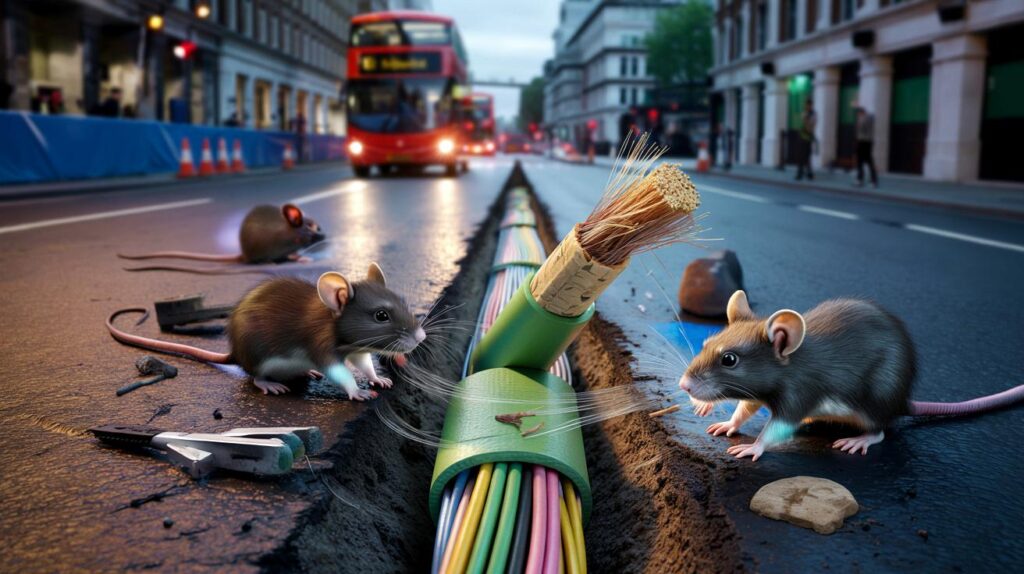
The mysterious outages trace back to a troubled fibre provider, a risky way of laying cables under busy roads, and an unexpected snack choice for urban rats: eco-friendly plastic that smells a little too much like food.
Rats gnawing on “green” fibre cables have helped sink a £300 million broadband operator and scupper a planned rescue deal.

How rats helped kill a £300 million broadband bet
The company at the centre of the drama is G.Network, a London-based fibre broadband provider that piled up around £300 million in debt while trying to roll out a citywide network.

On paper, the business still had value: around 25,000 remaining customers and a web of fibre running under some of the capital’s busiest streets. That made it a tempting target for rival Community Fibre, which began seriously examining a takeover.
The idea was simple. Community Fibre could absorb G.Network’s subscribers, fold the existing cables into its own infrastructure, and grow its market share in London without digging everything up again.
Then the engineers looked more closely at the cables.
They found extensive damage caused by rats, scattered across the network. Repairs would not only be expensive; they would be slow, disruptive and constant. The further they investigated, the worse the picture became.
Once the full extent of the rat damage emerged, Community Fibre reportedly walked away from the deal.
When going green bites back: soy-based cable jackets
Rodents nibbling on telecom lines is not rare. Farmers, rail operators and city councils have been dealing with it for decades. What makes this case stand out is the way modern “sustainable” cable design appears to have made the problem far worse.
To reduce reliance on fossil-fuel plastics, some manufacturers use polymers derived from plants such as soy and maize for cable jackets and protective ducts. These materials are designed to be more environmentally friendly during production and, in some cases, easier to recycle.
For rats, they can smell suspiciously like lunch.
Rodents have incredibly sensitive noses. Researchers and infrastructure operators suspect that volatile compounds released by soy- and corn-based plastics mimic food odours strongly enough to attract them. Instead of treating cables as just another hard object to gnaw on, rats appear to seek them out.
Eco-friendly coatings meant to make fibre greener may have turned thousands of cables into rodent bait.
Why rats chew anything even when they’re not hungry
There is also a basic biological driver. Rats, mice and other rodents have incisors that grow continuously throughout their lives. To keep them short and sharp, they must gnaw constantly on hard materials.
Fibre-optic cables and their outer sheaths happen to be almost perfect for that job. They are firm, resist a bit, and give rodents a satisfying surface to grind down their teeth. A single bite can crush or crack the delicate glass fibres inside, cutting connectivity for homes and businesses.
Engineer slang for this is simple: “rat bite”. On monitoring screens it often looks the same as a digger ripping up a line, just on a smaller but more frequent scale.
Why G.Network’s construction method made everything worse
The material issue alone would have been a headache. For G.Network, the bigger disaster was where the company put those vulnerable cables.
Instead of using existing ducts and chambers under pavements, G.Network often chose “micro-trenching”. That technique involves cutting a narrow slot directly into the road surface, usually just a few centimetres wide, dropping in the cable, and sealing it up again with asphalt.
Micro-trenching can be quicker and cheaper during the build phase. It avoids lengthy negotiations for space in crowded utility ducts, and it lets companies show rapid progress to investors and local authorities.
The downside arrives later: every maintenance job means cutting into the road again. Each time rats chew through a line, crews have to get traffic permits, roll out barriers, grind through asphalt and patch the surface afterwards.

Repairing a single rat-damaged segment could mean shutting a street, digging into tarmac and facing a stack of permits and costs.
The two big red flags for investors
According to those familiar with the review, two factors in particular alarmed would-be buyers:
- the heavy use of micro-trenching under busy carriageways, which makes each repair slow and expensive
- the spread and severity of rodent damage, suggesting an ongoing, not one-off, problem
Put together, they imply high operating costs for years. Every metre of damaged cable buried under asphalt is a future bill. For an acquirer, the question becomes: are you buying an asset or a liability?
Rats vs connectivity: a growing global headache
London is not alone in this. Telecom and power companies worldwide report millions in damage every year from rodents gnawing on lines, junction boxes and cabinets.
| Problem | Impact on networks | Typical response |
|---|---|---|
| Rodent chewing | Broken fibres, short circuits | Rodent-resistant sheaths, trapping, rerouting |
| Bird pecking or nesting | Sagging spans, damaged insulation | Bird guards, alternative nesting sites |
| Tree roots | Crushed ducts, pulled joints | Deeper ducts, root barriers |
| Construction work | Mass cable cuts | Better mapping, contractor education |
In some countries, utilities now specify rodent-resistant sheaths using bitter-tasting additives or tougher materials. Others place critical lines in sealed ducts, sometimes filled with gas or foam, making them less attractive and harder to reach.
The green push adds a twist. As plant-based plastics spread across sectors, from car parts to insulation, engineers need to test how wildlife reacts. A coating that biodegrades nicely in lab conditions might also emit scents that attract bored rats in a city alleyway.
What this means for city broadband projects
The G.Network saga is a cautionary tale about how small technical decisions can cascade into major financial risk.
For city authorities approving fibre rollouts, three questions now look more pressing:
- Where exactly will new cables be placed: under roads, pavements or in shared ducts?
- Which materials are used in cable jackets and protective pipes, and how do they behave around wildlife?
- How easy is it to access and repair the network after a fault, without paralysing traffic?
Permits for roadworks are already politically sensitive in dense cities. If every rat bite leads to a fresh set of temporary traffic lights and noise at 3am, patience will run out quickly.
Could design tweaks have saved this network?
Engineers point to a few practical measures that might have changed the story:
- using more conventional petrochemical jackets in high-risk areas, at least until bio-based alternatives are proven rodent-safe
- feeding cables through shared ducts or deeper trenches, even if upfront costs rise
- adding physical barriers or mesh around key sections where rodents are common, such as near sewers and rail lines
None of these steps guarantee safety. But each one reduces how often a rat can take a single bite and knock a neighbourhood offline.
Key terms and what they mean for customers
Two bits of jargon keep popping up in discussions of this case.
Fibre broadband: Unlike traditional copper lines, fibre-optic cables transmit data as pulses of light through strands of glass. They support much higher speeds and more stable connections, but the glass can be fragile if bent or crushed.
Micro-trenching: A low-impact digging method where a narrow cut is made in existing road or pavement, just big enough for a cable. It reduces initial disruption compared with deep trenches. The trade-off is trickier access once everything is sealed over.
For everyday customers, the main concern is reliability. If your provider relies heavily on micro-trenched routes with limited protection, faults may take longer to fix. That can matter for home workers, small businesses, and anyone relying on video calls or cloud services.
What might come next for rat-proof internet
The collapse of G.Network’s rescue attempt is likely to sharpen focus among investors and regulators on “whole-life” costs of digital infrastructure. A network that is cheap to build but expensive to maintain can be more fragile than it looks in early pitch decks.
There is active work under way to design smarter solutions: coatings that repel rodents, sensors that detect slight changes in light levels inside fibres when damage starts, and routing software that automatically shifts traffic away from suspect sections.
 Goodbye kitchen cabinets: the cheaper new trend that won’t warp, swell, or go mouldy over time
For now, the London case serves as a real-world test. Eco-themed marketing around “green cables” will be weighed against the hard numbers of emergency roadworks, compensation payments and failed takeovers. And somewhere under the tarmac, in narrow slots cut for a faster digital future, a few well-fed rats are still chewing on soy-flavoured plastic.