For decades, an eel‑like vampire fish quietly chewed through one of North America’s most valuable freshwater fisheries.
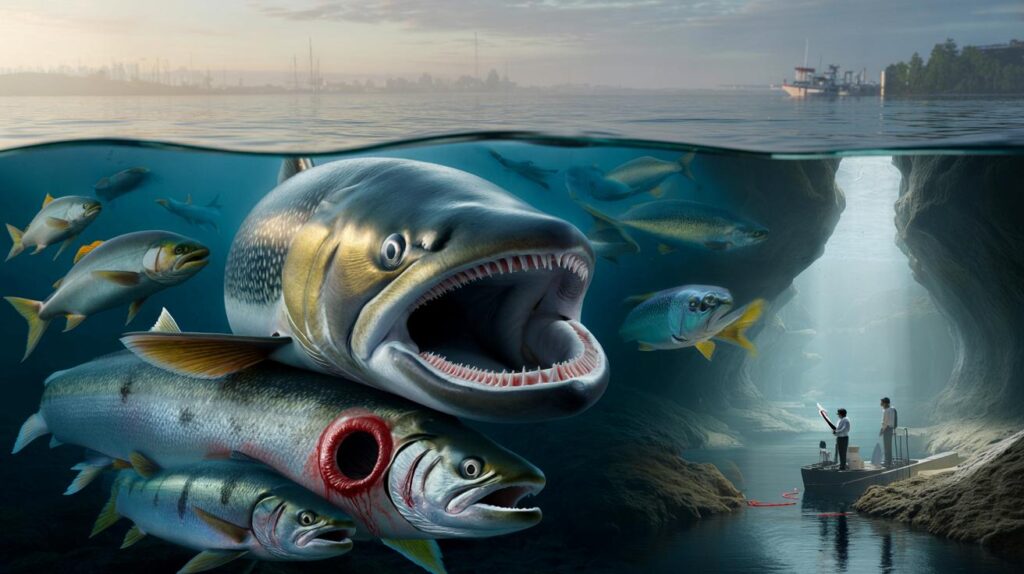
Today, the Great Lakes look healthy again from the surface, with thriving sport charters and bustling marinas, yet beneath that calm image, the battle against one of the region’s most damaging invasive species has never truly stopped.
How a jawless “vampire fish” upended a multi-billion dollar fishery
The sea lamprey looks like something from a horror film. It is not a true eel, but an ancient, jawless fish that predates the dinosaurs. Adults typically reach more than 30 centimetres in length. What really stands out is the mouth: a round suction cup lined with concentric rings of sharp teeth and a rasping tongue.

That strange anatomy lets the lamprey latch onto other fish and drill into their flesh. Instead of swallowing them whole, it feeds mainly on blood and body fluids. The host is left riddled with circular wounds, often so weakened that it dies later from stress or infection.

In its parasitic phase, a single adult sea lamprey can destroy the equivalent of up to 18 kg (40 lb) of fish.
In large, open oceans, native fish species have evolved alongside lampreys and can sometimes withstand attacks. The Great Lakes, though, were never meant to host this predator. For thousands of years, Niagara Falls formed a natural barrier that blocked sea lamprey from entering the upper lakes from the Atlantic.
That changed when humans re-engineered the landscape. New shipping canals and navigation routes built in the late 19th and early 20th centuries created a bypass around Niagara Falls. Along with cargo and people, they opened a corridor for the sea lamprey to move inland.
The stealth invasion that wiped out lake trout
Historical records show sea lamprey reaching the upper Great Lakes around the late 1800s. At first, few people noticed. The fish spread gradually, colonising tributaries and lakes step by step. By the 1930s, biologists were documenting infestations across all of the upper Great Lakes.
Before this invasion, lakes Huron, Michigan and Superior were famous for cold-water species such as lake trout and whitefish. Commercial harvests were steady and highly profitable, supporting fleets, processing plants and entire communities.
Lake trout in particular were the economic backbone. In the 1940s, commercial fisheries were landing around 7,000 tonnes of lake trout each year in some of these waters. Once sea lamprey numbers exploded, that changed with startling speed.
Lampreys attached themselves to large trout in huge numbers. Many fish reached nets scarred and bleeding. Plenty never made it that far, dying unseen in deep water. As the years passed, lake trout populations crashed across broad areas.
By 1962, the once-robust lake trout fishery had collapsed so badly in parts of the Great Lakes that managers shut down seasons entirely. Jobs vanished. Indigenous and non-Indigenous fishing livelihoods were hit. Processing plants closed. The ecological blow was just as severe as the economic one.
One invasive species effectively pulled the bottom out from under an entire freshwater fishery economy.
The steep price tag of an invisible predator
Today, the Great Lakes fishery is often valued at over US$7 billion a year, counting both commercial and recreational sectors. That figure underlines why governments decided they could not simply accept the loss brought by sea lamprey.
The crisis triggered one of the most ambitious invasive-species control programmes ever attempted in freshwater.
The chemical breakthrough that cut lamprey numbers by 90%
In the 1950s, US and Canadian agencies, working under the Great Lakes Fishery Commission, began a concerted hunt for a tool that could hit lampreys hard without poisoning the entire ecosystem. Researchers tested almost 6,000 chemical compounds on lamprey larvae and other organisms.
Eventually, they identified an especially useful candidate: 3‑trifluoromethyl‑4‑nitrophenol, known as TFM. This compound turned out to be selectively toxic to lamprey larvae at concentrations that most native fish and invertebrates could tolerate.
Biologists started applying TFM to tributary streams where lamprey larvae live buried in the sediment for several years before turning into parasitic adults. Treating these nursery habitats meant killing lampreys before they reached the lakes.
Within the early 1960s, regular TFM treatment cut sea lamprey populations in many areas of the Great Lakes by roughly 90%.

That rapid decline in predators opened a window for lake trout recovery, especially in the upper Great Lakes, where restocking combined with reduced lamprey pressure allowed self-sustaining trout populations to form again.
The turnaround was not instant. It took years of repeated treatments, careful monitoring and coordinated policy. But by steadily suppressing lamprey numbers, fisheries managers began to stabilise the ecological balance that had tipped so dramatically in the 1940s and 1950s.
Why you rarely see sea lamprey – and why they are still a threat
Tourists touring the Great Lakes today rarely glimpse a sea lamprey. That absence is misleading. The predator is still there, mostly hidden in tributaries and river bottoms during its larval stages or attached to deep-water fish where people do not often look.
One reason sightings are rare lies in the programme’s effectiveness. TFM and related “lampricides” are applied in tightly controlled doses and schedules. The compound breaks down naturally and does not build up in the food chain.
The US Environmental Protection Agency has reviewed TFM and, when used according to regulations, does not consider it an unacceptable risk for people or the wider environment. Some non-target species remain sensitive, so crews plan treatments carefully and monitor conditions.
Eradication of sea lamprey is unlikely. Instead, managers talk about long-term suppression. Current strategies blend several tools:
- regular lampricide treatments in infested streams and tributaries
- mechanical and electrical barriers that block adult lampreys from swimming upstream to spawn
- extensive monitoring of both invasive lampreys and native fish stocks
The Great Lakes Fishery Commission coordinates and funds control work across the basin. The Department of Fisheries and Oceans oversees efforts on the Canadian side, while US federal and state agencies share responsibility south of the border.
Not all lampreys are villains
One nuance easily lost in headlines: the invasive sea lamprey is not the only lamprey in the Great Lakes region. Several lamprey species are native to North America and form part of the natural ecosystem.
These native lampreys have evolved with local fish and do not trigger the same widespread collapses. Some are much smaller or spend less time feeding parasitically. Managers aim to target only the invasive sea lamprey, avoiding unnecessary harm to native species wherever possible.
The contrast is even sharper on the Pacific coast, where conservationists are working to restore native Pacific lamprey. In that context, lamprey are seen as ecologically valuable, supporting predators and Indigenous cultural practices.
In one watershed, a lamprey can be a destructive invader; in another, it can be a keystone species in need of protection.
Key terms and what they mean for the Great Lakes
| Term | What it means in this context |
|---|---|
| Invasive species | A non-native organism that spreads rapidly and causes ecological, economic or social damage. |
| Lampricide | A chemical designed to kill lamprey, especially their larval stages, while sparing most other species. |
| Tributary | A river or stream that flows into a larger lake or river; many lamprey larvae develop here. |
| Self-sustaining population | A fish stock able to reproduce and maintain its numbers without continuous stocking by humans. |
What a lamprey resurgence could look like
Fishery scientists sometimes run “what if” scenarios. One of the more worrying ones asks: what happens if lamprey control budgets are cut significantly, or if treatments become less effective?
Models suggest that even a few un-treated spawning streams can rapidly boost lamprey numbers. Because each adult can damage such a large mass of fish, the impact scales up fast. Managers could see more scarred salmon and trout, declining catch rates and renewed pressure on already stressed native populations.
Communities that rely on recreational fishing – charter captains, tackle shops, guides, tourism outfits – would likely feel the effects before the general public fully notices. Commercial operators, where they still exist, would face tougher economics. The cumulative effect across the basin could erode parts of that US$7 billion annual value.
Lessons for other regions facing invasive species
The Great Lakes lamprey saga has become a reference point for managing aquatic invasions worldwide. It shows how engineering projects such as canals can unintentionally open migration routes for species that radically reshape ecosystems.
It also demonstrates that sustained, science-based control can work, but only as a long-term commitment. Breaks in funding, gaps in monitoring or delays in responding to new outbreaks allow invaders to regain ground.
 Goodbye kitchen cabinets: the cheaper new trend that won’t warp, swell, or go mouldy over time
For river basins elsewhere weighing new navigation channels or water transfers, the Great Lakes offer a cautionary case study: one uninvited species, slipping through a man-made corridor, can rewrite both ecology and economy for generations.