
The photo loads slowly on the laptop screen, one pixelated smear at a time. At first it looks like nothing more than a soft bluish smudge against a velvety black background, interrupted by a scatter of stars you might scroll past without a second thought. Then your eye catches the twist of a tail, an almost serpentine wake of dust and gas, and the realization hits: this icy fragment has sailed in from another star system entirely.
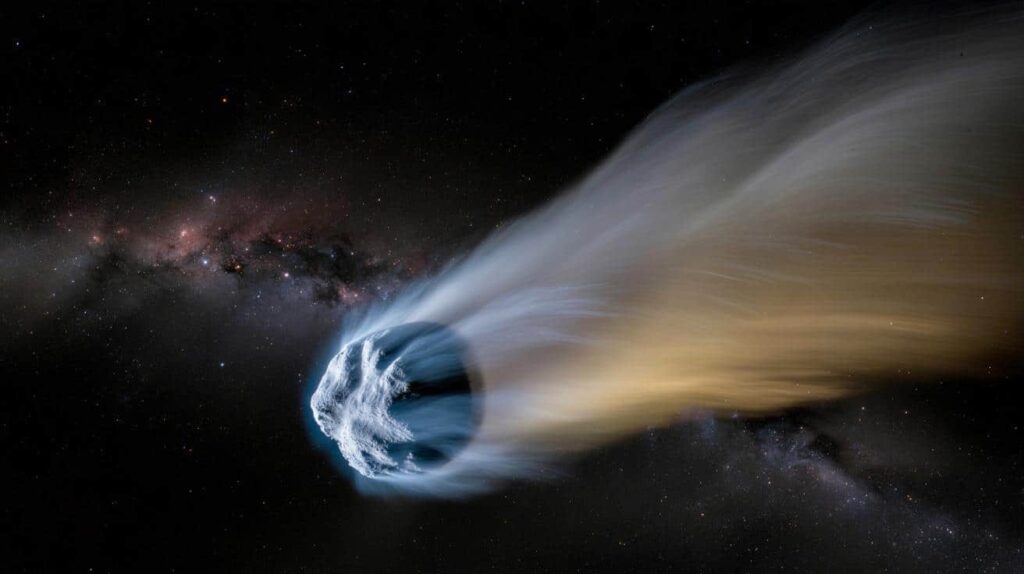
Somewhere on a mountaintop half a world away, an astronomer sips lukewarm coffee and watches the same object crawl across a monitor.
Comet 3I ATLAS is only a visitor.

But the new images it’s leaving behind are breathtaking.

The alien wanderer lighting up our telescopes
Comet 3I ATLAS doesn’t belong here. It’s moving too fast, on too open a path, slipping through our Solar System like a stranger who never plans to stay. This is only the third known interstellar comet, and you can feel that sense of rarity in every frame astronomers have captured.
From Hawaii to Chile to the Canary Islands, major observatories have swung their mirrors onto the same faint intruder. The result is a patchwork portrait: razor-sharp images in different colors, taken under different skies, stitched together by human curiosity.
On one crisp winter night at the Very Large Telescope in Chile, the observing room went unusually quiet. A new exposure had just come in from one of the instruments tuned to pick up faint structures in the comet’s tail.
Onscreen, 3I ATLAS showed a surprisingly complex shape, with delicate jets fanning out from the nucleus like translucent feathers. A senior astronomer leaned closer, muttering that it looked less like the neat textbook comets of his youth and more like a storm cloud, halfway torn apart by the Sun’s radiation. For a few seconds, everyone simply stared.
These images are more than pretty space posters. They’re data slices, each pixel encoding brightness, color, motion. When observatories like Mauna Kea, La Palma and the European Southern Observatory compare their shots, they get a time-lapse of how the comet changes as it speeds along its hyperbolic path.
The brightness tells them how much ice is turning to gas. The color reveals the mixture of dust and molecules boiling off the surface. The shape of the tail sketches the invisible wind of charged particles blowing out from our Sun. Piece by piece, they can reconstruct what an alien comet is truly made of.
Why these new images are such a big deal
For astronomers, 3I ATLAS is like a free sample dropped on our doorstep by another planetary system. Normally, to study how comets form around other stars, we rely on indirect tricks: faint dips in starlight, hints of dust rings, computer models stacked on top of assumptions.
This time, the sample came to us. The new multi-observatory images show that 3I ATLAS carries unusual ratios of dust to gas, and a surprisingly lumpy, asymmetric coma. That hints at a formation history under different conditions than those in our own early Solar System. We’re essentially looking at someone else’s cosmic recipe.
Think back to the first interstellar interloper, 1I/‘Oumuamua, racing past in 2017. It was gone almost as soon as we found it, leaving us bickering over whether it was a cigar, a pancake, or something stranger. Then came 2I/Borisov, a more classic-looking comet that telescopes around the world rushed to catch.
Astronomers learned from those near-misses. This time, with 3I ATLAS, the global response was almost choreographed. Robotic telescopes flagged its odd trajectory fast. Bigger observatories scheduled urgent follow-up time. Amateurs joined in, feeding brightness measurements to shared databases. That coordination is exactly why the new images feel so astonishingly detailed: this is what happens when the whole planet decides to look together.
At the heart of it all is a technical challenge that sounds simple on paper: photograph something small, faint, and moving. Long exposures blur the comet against the stars. Short ones lose the fine structure in the tail. Each observatory solves that trade-off differently, adjusting tracking rates, filters, and timing.
 Polar bears in Norway’s Arctic are getting fatter and healthier, despite the climate crisis
When they combine all those strategies, they catch details that any single telescope would miss: faint streamers peeling off the main tail, a subtle color gradient from icy gases to darker, heavier dust, even hints of knots where jets might be rotating with the nucleus. *This is slow, painstaking work that looks effortless only once you see the final images shared on social media.*
How you can “read” these images like an astronomer
The next time you see one of the new 3I ATLAS photos pop up on your feed, try looking at it with a slightly more trained eye. Start with the core, that bright fuzz at the center. That’s the coma, the cloud of gas and dust boiling off the solid nucleus hidden inside. If the coma looks lopsided or off-center, that’s a hint the nucleus is irregular or spinning in a messy way.
Then let your gaze slide along the tail. A straight, narrow tail usually shows gas being pushed by the solar wind. A broader, slightly curved one often traces heavier dust, lagging behind like sand thrown from a car window on a highway.
If you’ve ever zoomed in too far on a phone photo and watched it turn into mushy pixels, you already know a bit of what astronomers wrestle with. They fight noise, atmospheric shimmer, even stray reflections inside the telescope. That’s why some images look crisp and almost minimalist, while others glow in saturated blues and greens once processed.
Let’s be honest: nobody really follows the calibration steps every single amateur astrophotography guide suggests. Professional teams slip up too. A tiny processing choice can make a faint jet disappear or exaggerate it. That’s why multiple observatories and teams looking at the same comet are so crucial; their mistakes and biases don’t all point in the same direction.
The scientists working on 3I ATLAS know that the public will mostly remember the most dramatic, almost sci‑fi looking pictures. They’re fine with that, as long as some of the real story sneaks through with the wow factor.
“Every new image of an interstellar comet is like a postcard from a star we haven’t met yet,” one researcher told me. “The details in the dust and gas are messages about where this object was born, and how alien or familiar that place might be.”
- Look at the coma: its shape and brightness hint at the comet’s spin and activity.
- Compare the colors: different filters reveal different molecules and dust sizes.
- Check the stars: streaked stars mean the telescope tracked the comet’s motion.
- Notice repeat shots: time-lapse sequences show how the comet evolves night by night.
- Watch for scale bars: they quietly tell you just how vast that delicate-looking tail really is.
The quiet feeling behind a world staring at the same speck
There’s something a little humbling about knowing that while you scroll past a comet photo on a phone, a whole network of people has spent months coaxing that image out of the night. Graduate students losing sleep over guiding errors. Engineers tweaking mirror alignments in the cold. Amateur observers watching from backyards, cheering when their blurry frames align with the professionals’.
We’ve all been there, that moment when you suddenly feel very small and, weirdly, more connected at the same time. An interstellar comet crossing our sky does that at a planetary scale.
3I ATLAS will swing past and fade, slipping back into the deep dark between stars, never to return. The images, though, will stick around, quietly reshaping how we imagine the space between stellar neighborhoods. They hint that the void is not empty at all, but full of wandering ice, dust, and rock carrying stories from one system to the next.
Those stories are written in photon counts and spectral lines, in the fine hairs of a tail captured by a telescope thousands of kilometers away from where you’re reading this.
Next time another interstellar visitor is spotted, the playbook honed on 3I ATLAS will be ready: faster alerts, sharper images, better questions to ask. Until then, we’re left with these spectacular portraits of an object that never meant to stop here, and yet has become a shared point of focus for our entire species.

The plain truth is that most of us will never peer through a giant observatory eyepiece, but these pictures let us borrow that view for a moment. Whether you see in them a scientific data set, an alien artifact, or just something quietly beautiful glowing against the void, the invitation is the same: pause for a second, and look up.

| Key point | Detail | Value for the reader |
|---|---|---|
| Interstellar nature of 3I ATLAS | Its hyperbolic path and speed show it came from beyond our Solar System | Gives a rare, direct glimpse into how comets form around other stars |
| Global observing campaign | Major observatories coordinated to capture multi-wavelength, time-lapse images | Explains why current photos are so detailed and trustworthy |
| How to “read” the images | Coma shape, tail structure and colors each encode specific physical information | Helps you look at viral comet pictures with a more informed, curious eye |
FAQ:
- Is 3I ATLAS dangerous for Earth?
No. Its trajectory takes it safely past our planet, on a path that never brings it close enough to pose any impact risk.- Why is it called “3I ATLAS”?
“3I” means it’s the third known interstellar object (“I” for interstellar), and “ATLAS” comes from the survey telescope system that first spotted it, the Asteroid Terrestrial-impact Last Alert System.- Can I see 3I ATLAS with the naked eye?
Probably not. Current estimates suggest it remains too faint for unaided vision, though a decent amateur telescope under dark skies might catch it as a small, fuzzy patch.- What makes the new images so special?
They combine views from several large observatories, in different filters and at different times, revealing subtle jets, color changes and tail structures that a single telescope would likely miss.- Will we ever send a spacecraft to an interstellar comet?
Not to 3I ATLAS; we found it too late to plan and launch a mission. Space agencies are studying “rapid-response” concepts so that a future interstellar visitor might one day get a close-up probe flyby.
