
The first time you see it on satellite images, your brain hesitates for a second. Those little pale-green smudges in the middle of the ocean, ringed by turquoise, look like watercolor stains, not land. Then you zoom in. A runway appears. A pier. Radar domes that cast hard shadows in the tropical sun. You blink, half expecting the pixels to rearrange and admit it was a glitch. They don’t. The islands are real, and a lot newer than your phone.
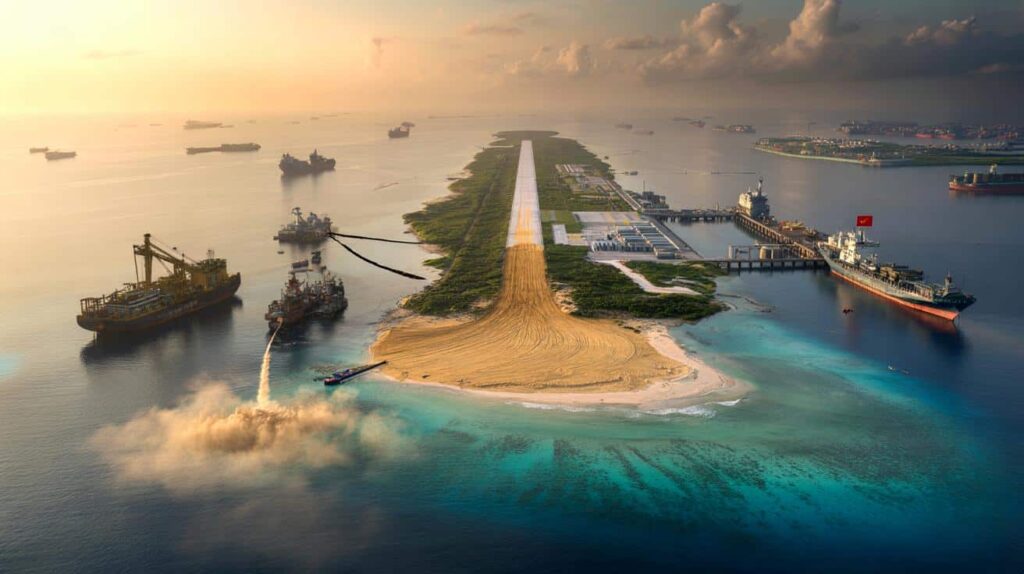
Somewhere below those runways, there used to be nothing but waves, coral, and silence.
China has been pouring sand into that silence for over a decade.

From empty reef to military airstrip in a handful of years
If you stand on the deck of a fishing boat in the South China Sea at dawn, the horizon looks almost innocent. Low clouds, a pale strip of water, the hum of engines. Then, out of the haze, a grey line starts to rise. At first you think it’s a ship. A few minutes later, the shape hardens into seawalls, cranes, and a runway so long it splits the sea like a scar.

This is how China’s new islands introduce themselves: not with beaches, but with concrete and radar.
For more than 12 years, Chinese dredgers have been scooping up sand from the seabed and dumping it over reefs and shallow banks. Think of floating factories, sucking up sediment through fat hoses and spewing it onto the reef like a mechanical volcano. On Fiery Cross Reef, Subi Reef, and Mischief Reef, this process turned tiny outcrops and half-submerged atolls into artificial islands big enough for three-kilometre airstrips.
Engineers then wrapped the new land in rock and concrete, stabilizing it against waves and storms. Where once only fishermen dropped anchor, there are now fuel depots, hangars, lighthouses, helipads, and deep-water ports that can host warships.
Why go to all this trouble in the middle of nowhere? Because these waters are anything but empty. The South China Sea is one of the world’s busiest shipping lanes, a crossroads for container ships headed to Europe, Africa, and the Americas. Beneath the waves lie oil and gas fields, fisheries that feed millions, and sea routes that can decide the fate of economies.
By creating islands from scratch, China is not just moving sand. It is shifting invisible lines of power drawn across water.
How to “grow” an island: China’s playbook, step by step
Island-building sounds almost magical until you break it down into the messy, mechanical steps. First comes the claim: China draws its “nine-dash line” over most of the South China Sea and marks reefs as its own, even when they’re closer to the Philippines, Vietnam, or Malaysia. Then come the ships. Survey vessels arrive, scanning depths and mapping coral structures like doctors reading X-rays.
Once engineers find a shallow-enough base, the dredgers move in. They circle the reef day and night, chewing up sand and mud, then pumping it on top of the coral to raise the sea floor above water.
From there, it looks a lot like a chaotic construction site you might see on land, just floating. Bulldozers crawl across wet sand that didn’t exist last year. Trucks bring in steel and cement. Seawalls go up, then piers, then the unmistakable long, straight ribbon of a runway. The transformation is fast enough that time-lapse satellite videos feel unreal: blue water, then a beige smear, then suddenly a geometric island with roads and buildings.
We’ve all been there, that moment when you return to a place you knew and barely recognize it. Now imagine that feeling happening to an entire ocean.
Behind the steel and concrete lies a simple strategic logic. Under international law, natural islands generate territorial waters and economic zones; low-tide reefs and artificial platforms do not in the same way. So China leans on a mix of historical claims, vague “traditional rights,” and the raw fact of presence. Naval patrols, coast guard vessels, and aircraft often depart from these new bases, turning abstract legal disputes into something much more physical.
Let’s be honest: nobody really reads maritime arbitration rulings every single day. What people notice are ships, fences, and flags. By building islands, China has given its flag fresh ground to fly from in the middle of contested seas, and that changes how everyone else behaves there.
The hidden costs: coral, climate, and a nervous neighborhood
There is a method to this island-making, but there is also a price, and the ocean pays first. When a dredger bites into the seabed, it doesn’t just move neutral sand; it smothers coral reefs and the complex communities that live around them. Marine biologists looking at satellite imagery and underwater surveys estimate that large chunks of reef have been scraped, buried, or clouded in silt across the Spratly Islands.
These reefs were nurseries for fish, breakwaters against storms, and living archives of biodiversity. Once flattened and entombed under concrete, they don’t just “bounce back” in a couple of seasons.
Coastal communities across Southeast Asia have felt the ripple effects. Fishermen from the Philippines or Vietnam who once worked these waters now talk about being shadowed, warned off, or boarded by Chinese coast guard ships based on the new islands. One season, the catch is good; the next, boats come back half-empty and full of stories about run-ins near artificial shorelines that didn’t exist when they were kids.
There’s a subtle, human stress behind the geopolitics: the fear of crossing an invisible line that seems to move with each new patch of land.

Scientists also point out an awkward irony. At a time when the world is losing coastal land to rising sea levels, China is literally manufacturing new shorelines. The process burns fuel, emits carbon, and hardens delicate marine ecosystems into heat-absorbing infrastructure. Neighboring countries watch this unfold with a mix of anger, envy, and anxiety.
Some quietly study the techniques, wondering if they should build their own islands to avoid being outflanked. Others double down on legal challenges and alliances, hoping that international rules can catch up with what’s already poured in place. *When one nation proves that enough sand and political will can redraw the map, it tempts others to reach for the dredgers too.*
What this means for the rest of us
You might never set foot on Fiery Cross Reef or Subi Reef, but their existence still brushes your everyday life. The phone in your hand, the clothes you’re wearing, the food in your supermarket: much of it passed through shipping lanes that thread the South China Sea. When new islands appear near those routes, bristling with runways and radars, shipping companies quietly adjust paths, insurers tweak risk models, and navies schedule more patrols.
A few meters of artificial land can bend the path of trillions of dollars’ worth of trade.
The emotional trap here is to shrug and think, “That’s just how big powers behave, nothing to do with me.” It’s a normal reaction, especially when the story feels far away and wrapped in jargon. The plain truth is that today’s remote dredging project is tomorrow’s price spike at your local gas station, or the headline about a naval standoff you wake up to on your commute.
The more crowded and armed those little specks of concrete become, the smaller the margin for error in a region already full of old grudges.
One diplomat from Southeast Asia summed up the mood in a private conversation:
“Every new island is like a permanent argument poured in cement. It doesn’t go away when governments change. It just sits there, waiting for the next crisis to grow around it.”
For readers watching from a distance, a few key threads stand out:
- Follow the sand: island-building isn’t just a construction story, it’s a clue to future flashpoints.
- Watch the neighbors: how Vietnam, the Philippines, Malaysia, and Indonesia react will shape the region’s balance of power.
- Connect sea and climate: what happens to reefs and coasts here links directly to global debates on oceans, food, and resilience.
As tiny as they look on the map, these new islands are loud signals about the world we’re sliding into.
What kind of world builds islands to win arguments?
There’s something both awe-inspiring and unsettling about this whole story. On one hand, the sheer technical feat is hard to deny: turning scattered reefs into solid runways in a few short years shows what modern engineering can do when money, machines, and political resolve line up. If humans can grow islands in open water, what else could we reshape if we truly wanted to?
On the other hand, the choice of where that power gets directed says a lot about us. Instead of protecting fragile reefs, we’re burying them. Instead of cooling tempers in a tense region, we’re cementing new friction points into the seafloor.
These islands raise awkward questions that linger long after the dredgers move on. Who gets to decide where land begins and ends in the 21st century? What happens when one country’s “defense” project reshapes the food supply and livelihoods of people in another? At what point does building in the ocean stop being engineering and start being a form of quiet, irreversible annexation?
You don’t need to be a policy expert to feel that something fundamental is shifting when maps change not because of earthquakes or erosion, but because someone ordered a fleet of dredgers to work overtime.
Next time you glance at a world map, try to imagine it as a living document rather than a fixed truth. Somewhere out there, as you read these lines, engines are humming, pumps are grinding, and fresh sand is raining down on a reef you’ve never heard of. In a decade, that spot might have a name, an airstrip, a radar, a dispute, and a story attached to it.

Whether that story leans more toward cooperation or confrontation will depend, in part, on how the rest of the world decides to respond to the idea that land itself has become just another project.
 A polar vortex disruption is on the way, and its magnitude is almost unheard of in February
| Key point | Detail | Value for the reader |
|---|---|---|
| China has built artificial islands over more than 12 years | Dredgers pumped sand onto reefs like Fiery Cross, Subi, and Mischief to create bases with runways and ports | Helps you grasp how fast and physically these “new lands” have appeared |
| Strategic control of the South China Sea is at stake | The area carries a huge share of global trade and hides rich fisheries and energy reserves | Shows how distant island projects can affect prices, supply chains, and regional stability |
| Environmental and political costs are mounting | Coral reefs are damaged, tensions with neighbors are rising, and other states may copy the model | Offers a lens to read future headlines about oceans, climate, and great-power rivalry |
FAQ:
- Question 1How exactly does China turn a reef into an island?By sending in dredging ships that vacuum sand and sediment from the seabed and pump it onto shallow reefs, raising them above sea level, then reinforcing the new land with rock, concrete, and infrastructure like runways and piers.
- Question 2Are these artificial islands legal under international law?International tribunals have rejected many of China’s claims in the South China Sea, and artificial islands don’t automatically generate full maritime zones, but Beijing continues to assert control based on its own interpretation and on-the-ground presence.
- Question 3What damage do these projects do to the environment?The dredging and land reclamation bury coral reefs, stir up sediment that can kill marine life, and replace complex habitats with hardened surfaces that reflect heat and alter local ecosystems.
- Question 4Why should people outside Asia care about these new islands?Because they sit astride some of the world’s most vital shipping lanes, so any tension or conflict around them can affect global trade, energy flows, and economic stability far beyond the region.
- Question 5Could other countries start building their own islands too?Some already have smaller projects, and China’s success may tempt others to expand, raising the risk that artificial islands become a common tool in territorial disputes and further stress fragile marine environments.
