
No wind turbines, no glittering solar panels. Just wet grass, a muddy track, and a small, humming rig drilling into the earth. Yet the laptop next to it is flashing strange readings – numbers that whisper something explosive: natural hydrogen, bubbling up from deep rocks, on a scale no one thought possible in Europe.
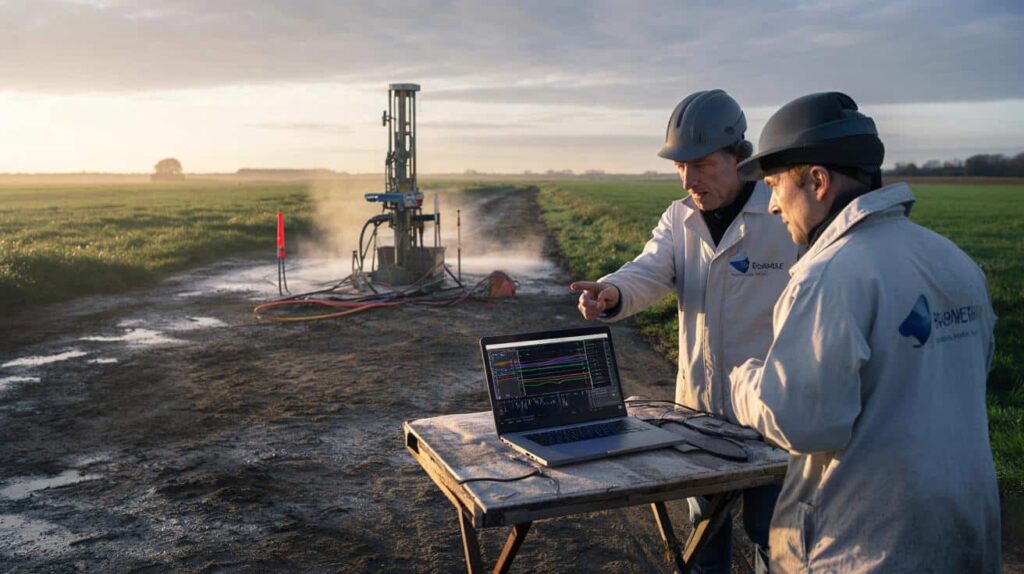
The air smells of soil and oil. Someone mutters, half-joking, “If this is real, we’re sitting on a goldmine.” Another replies, “Not gold. Better than gold.” The scene feels strangely low-key for what some headlines are already hailing as a revolution in clean energy.
Still, a quiet doubt hangs in the air. Because the real obstacle to this “white hydrogen” era might not be lurking where everyone imagines.

France’s underground surprise isn’t the story people are telling
Standing in the village of Folschviller in Lorraine, where France’s latest “white hydrogen” buzz started, you’d hardly guess this place might redraw the energy map. Old coal country, shuttered mines, ageing houses, a supermarket car park that never quite fills. Yet researchers say the rocks below could be streaming natural hydrogen for decades, maybe centuries.

For a country under pressure to wean itself off fossil fuels without sending energy bills through the roof, that sounds like a dream. **No giant offshore platforms. No vast solar farms eating up farmland.** Just wells, pipes and geology quietly doing the work. The story writes itself: France, energy independent, exporting clean molecules instead of buying gas from unstable suppliers. Politicians love that image. Social media loves it even more.
But the people who actually spend their lives staring at rocks and gas samples are much less euphoric. Their message is blunt: the hype is pointing at the wrong bottleneck.
The big number making headlines comes from early estimates that Lorraine alone might hold tens of millions of tonnes of natural hydrogen. Some commentators immediately started waving around comparisons with decades of French energy demand, as if this discovery were a new North Sea in disguise. It feels intoxicating. Vast, almost mythical.
Take a step back, though, and the questions start piling up. How much hydrogen is really there? At what pressure? How does it flow? Can you tap it reliably, year after year? In oil and gas, those questions took generations to answer, with thousands of wells drilled and billions burned in trial and error.
With white hydrogen, we’re closer to the first scribbles on a napkin than to a full business case. And the deeper scientists drill, the more they insist that geology is only half the story. The tougher half lies above ground, in steel, permits, and people.
The real choke point: what we do at the surface, not what lies underground
If you talk privately with hydrogeologists and reservoir engineers in France right now, a pattern emerges. They’re not losing sleep over whether the earth can produce hydrogen. They’re losing sleep over whether society can handle it at scale, fast enough, without tripping over its own rules.
The technical path from a promising hydrogen-bearing rock layer to a working energy system is brutally simple on paper. You drill. You produce the gas. You clean it. You transport it. Someone pays for it. Reality is messier. Pipelines have to cross fields and villages. Storage caverns must be carved out and monitored. Safety codes, still written with natural gas in mind, suddenly look incomplete.
Hydrogen is small, leaks easily and behaves differently in metal pipes than methane. Existing gas networks can’t just swallow infinite amounts of it without upgrades. That means concrete decisions on who funds what, and when. *This is the kind of slow, bureaucratic friction that doesn’t go viral on TikTok, but quietly kills revolutions.*
Think back to how long it took Europe to roll out wind energy in a serious way. The turbines themselves work; the physics was never in doubt. The delays came from planning battles, grid connections, local resistance, fragile supply chains. White hydrogen is walking a similar path, with an extra twist: it’s trying to enter a market where “green” and “blue” hydrogen projects already fight for subsidies and attention.
Behind the scenes, you hear the same sentence from weary researchers: the geology will be solved faster than the paperwork.
How France could avoid turning white hydrogen into just another missed chance
So what would it look like to treat France’s white hydrogen as a real energy option, not just a PR story? On the ground, the experts describe something almost boring: focused test fields, small clusters of carefully monitored wells, and a controlled build-up of infrastructure around them.

Instead of chasing the biggest headline number, the smarter move is to pick two or three sites and do them almost obsessively well. Full baseline studies of local groundwater. Transparent monitoring of micro-seismicity. Public dashboards showing what’s being produced, what’s being flared, what’s being reinjected. **Not because it looks pretty for investors, but because it buys trust.**
Once you have that trust, the engineering becomes easier. Local councils become more willing to host pilot pipelines. Residents are more open to storage projects. The conversation shifts from abstract fear to concrete negotiation: how many trucks, which roads, what compensation, what jobs. Without that, even the most promising well risks becoming another symbol of “Paris deciding for everyone else”.
There’s also a very practical trick energy planners keep repeating: connect early hydrogen production to nearby industrial users, not distant, shiny new projects. Refineries, chemical plants and steelworks already use hydrogen. Swapping in local white hydrogen, even in small volumes, proves value immediately. That’s less glamorous than fueling a futuristic fleet of hydrogen taxis, but far more stabilising for the business case.
Soyons honnêtes : personne ne fait vraiment ça tous les jours. Ordinary people aren’t going to follow the nuances of geochemical reactions or porosity curves. They react to what they see and feel. Noise. Traffic. Jobs. Smells. Safety drills at the local school.
When those everyday details are ignored, resistance hardens fast. French history is full of energy projects that looked rational on paper but ran into a wall of mistrust once the diggers arrived. On a cold evening in a community hall, a glossy slide about “national sovereignty” does not stand a chance against a worried parent wondering what happens if a hydrogen pipe ruptures near the playground.
That’s why some of the most convincing voices in this story aren’t engineers at all, but sociologists of technology. They point out that new energy sources don’t just replace old ones; they reorganise power, money and landscape. People sense that, instinctively, even if they don’t phrase it that way. We’ve all sat through that meeting where the project looks tidy on PowerPoint but feels wrong in the gut.
Scientists who work on white hydrogen know this unease matters. Many are starting to call openly for “co-design” of projects with local communities, not just bland public consultations. That word sounds soft, but behind it lies a hard reality: without shared ownership of the process, the smartest subsurface model won’t get a single molecule to market.
“The resource is exciting, but the fantasy that geology alone will save us is dangerous,” one French geochemist told me. “We keep pretending the bottleneck is down there in the rock. It’s right here, in how we organise ourselves.”
For readers watching this story unfold from their phones and laptops, that might feel frustrating, almost anticlimactic. You come for the bold discovery, you stay for the slow grind of governance. Yet there are some very practical lenses you can use to cut through the noise and judge each new “hydrogen miracle” headline for yourself:
- Who will actually buy the first volumes of hydrogen, and at what price?
- Is there a clear plan for pipelines or transport, not just production?
- Have local councils publicly endorsed the pilots, or are they staying silent?
- Are independent scientists, not just company spokespeople, sharing data?
- What happens if the flow rate is lower than hoped – does the project still make sense?
What this quiet French field reveals about our hunger for miracles
There’s something almost cinematic in the idea of France discovering vast seams of clean hydrogen below its feet just as the world scrambles to decarbonise. It scratches a deep itch: the hope that a single technological twist might spare us the messy, collective work of changing how we power and organise our lives.
The more you listen to the people actually mapping these hydrogen systems, the more that fantasy unravels. The subsurface story is fascinating – the reactions between iron-rich rocks and water, the slow generation of H₂ over time, the possibility of self-replenishing reservoirs. But the plot twist is up here, in our regulations, our grids, our ability to argue without freezing every project for ten years.
We’ve all lived through that moment where a promising solution gets buried under fights, delays and half-truths until no one remembers what the original idea was. White hydrogen sits exactly at that crossroads. It could become a powerful new tool in Europe’s energy mix. Or it could join the long list of “nearly revolutions” that looked amazing in early press releases, then faded away as the real bottlenecks – social, political, logistical – tightened their grip.

That’s why this story is worth following beyond the first wave of excitement. Not to hunt for a hero molecule, but to watch how a country negotiates the gap between what its rocks can offer and what its institutions can actually deliver. Somewhere between those two layers, far from the drill bit and far from the slogan, the true shape of France’s hydrogen future is being drawn, line by line.
 A polar vortex disruption is on the way, and its magnitude is almost unheard of in February
| Point clé | Détail | Intérêt pour le lecteur |
|---|---|---|
| White hydrogen isn’t automatic salvation | France’s subsurface may hold large natural hydrogen reserves, but real output and economics remain uncertain. | Avoids overreacting to hype and helps you read big numbers with a critical eye. |
| The main bottleneck is above ground | Pipelines, storage, safety rules, public acceptance and customers will decide if projects fly. | Shows where political and civic pressure can genuinely shape outcomes. |
| Local trust can make or break projects | Transparent pilots, nearby industrial offtakers and shared decision-making matter more than slogans. | Offers concrete cues to judge whether a given project is serious or just storytelling. |
FAQ :
- What exactly is “white hydrogen”?It’s naturally occurring hydrogen found underground, generated by geological processes, as opposed to hydrogen made in factories from gas (“grey/blue”) or renewables (“green”).
- Is France really sitting on huge hydrogen reserves?Early studies in regions like Lorraine suggest significant potential, but the exact size, quality and producibility are still being tested.
- Is white hydrogen automatically climate-friendly?Burning hydrogen produces only water, yet drilling, processing and transport can carry environmental risks and emissions, depending on how projects are run.
- Could this discovery cut French energy bills quickly?Not quickly. Developing a full value chain – wells, pipelines, storage, users – takes years, even with strong political will and investment.
- What should I watch for in coming years?Look for concrete pilot projects with transparent data, local support, industrial buyers lined up and clear plans for infrastructure, not just optimistic resource estimates.
