
The first time you kick off your shoes after a long day and walk barefoot through your home, there’s a tiny moment of shock. The floor feels colder than you expected. The tiles are harder, the wooden boards slightly uneven, the rug surprisingly soft. Your feet, usually trapped in sneakers or slippers, suddenly feel… awake.
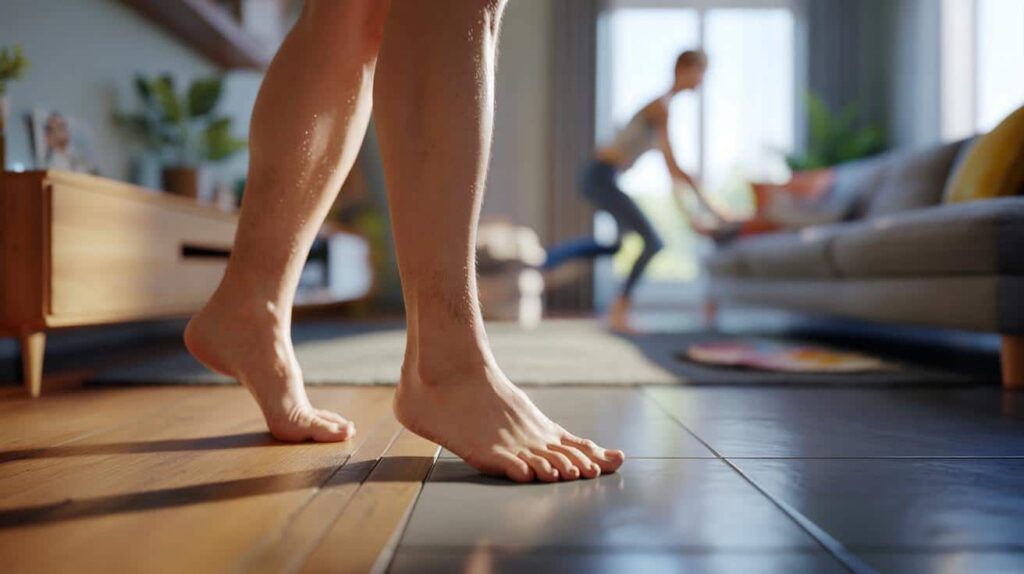
You wiggle your toes without thinking, spread them a little, adjust your step. You don’t know it yet, but your brain is already doing a quiet recalibration.
The body loves these small, repeated experiments.
And balance, strangely enough, starts right there on the living room floor.

Why your bare feet secretly train your balance
When you walk barefoot at home, you give your feet a job they rarely get at the office or outside: actually feeling the ground. Every tiny contact point — toes, ball of the foot, heel, arch — sends information to your brain.

Your nervous system uses those signals to decide how hard to push, how wide to step, how much to contract your muscles. Shoes filter a lot of that out. Barefoot, the feedback is louder and more precise.
Over time, this constant stream of data becomes a quiet daily workout for your balance.
Think of someone you know who always seems “sure-footed.” Maybe it’s that older neighbor who moves confidently on stairs, or a friend who never slips on wet pavement. Ask them about their habits and you’ll often hear something like, “Oh, I’m always barefoot at home.”
Physiotherapists see this pattern all the time. People who grew up largely barefoot, or who regularly walk barefoot indoors, tend to have better ankle stability and quicker reflexes when they stumble.
They’re not doing balance exercises in a gym. Their training ground is the hallway between the kitchen and the bedroom.
There’s a simple logic behind this. Your feet contain thousands of sensory receptors, like high-definition cameras pointing downwards. When they’re pressed directly against the floor, those receptors detect pressure, temperature, and texture.
Your brain then builds a detailed “map” of where your body is in space. That map is what helps you avoid rolling your ankle, recover from a misstep, or shift your weight smoothly when you turn.
Less shoe padding means more information. More information means better balance over time.

How to use barefoot time at home as a mini balance workout
Start small. Begin with 10–15 minutes barefoot at home in a part of your space that feels safe: the hallway, the kitchen, near the couch.
Walk a bit slower than usual. Notice how your heel touches first, how your weight rolls across the arch, how your toes gently push off. Try spreading your toes inside the step, giving them space to move.
This isn’t about being “natural” or perfect. It’s about letting your feet wake up and do what they’re built for.
If you’re not used to walking barefoot, your soles might feel tender at first. That doesn’t mean you’re doing it wrong; it means your feet are adapting.
Take it as a signal to go gradually. Alternate between barefoot and wearing light, flexible socks or minimalist slippers. Avoid suddenly spending the whole weekend barefoot if you’ve been in cushioned shoes for years.
Let’s be honest: nobody really does this every single day. Progress comes from consistency over weeks, not from a heroic barefoot Sunday.
*“When patients walk barefoot indoors regularly, their balance usually improves without them noticing. Then one day they realize they can handle stairs, curbs, or crowded sidewalks with less fear,”* says a physical therapist who works with seniors and athletes.
- Walk barefoot for 10–20 minutes a day on safe, clear floors.
- Mix surfaces: tile, wood, rug, yoga mat, even a folded towel.
- Try simple drills: stand on one leg while brushing your teeth, then switch.
- Use the sofa or wall as support if you feel unsteady at first.
- Stop if you feel sharp pain, and build up time week by week.
What changes when you let your feet “see” the ground again
Spend a few weeks walking barefoot at home and strange little things start to change. You roll your ankle less often on uneven pavement. You catch yourself more quickly when you trip over the dog toy. You feel more grounded when you climb stairs or stand in a moving bus.
 Bad news for homeowners: starting February 15, a new rule bans lawn mowing between noon and 4 p.m.
It’s not magic. It’s your foot muscles getting stronger, your joints learning to stabilize faster, your brain trusting your feet again.
Balance stops feeling like a mysterious quality other people have and becomes something you quietly train while making coffee.

| Key point | Detail | Value for the reader |
|---|---|---|
| Barefoot wakes up foot sensors | Direct contact with the floor sends rich information to the brain | Improves balance reactions in everyday life |
| Small daily habits beat rare workouts | 10–20 minutes barefoot at home acts like micro training | Easy, realistic way to build stability over time |
| Varied surfaces challenge your system | Rugs, tiles, wood and mats each stimulate balance differently | Helps the body adapt and feel safer on changing ground |
FAQ:
- Can everyone walk barefoot at home safely?If you have diabetes, severe foot deformities, or circulation issues, talk to a podiatrist or doctor first. For most healthy people, starting slowly on clean, clear floors is generally safe.
- How long should I stay barefoot each day?Begin with 10–15 minutes and see how your feet feel. You can build up to 30–60 minutes split across the day if it feels comfortable and natural.
- Will barefoot walking fix my balance problems on its own?It can help a lot, but if you already have strong balance issues, it’s only one tool. Pair it with guided exercises from a physiotherapist, and rule out medical causes.
- What if my feet hurt when I walk barefoot?Mild sensitivity at first can be normal. Sharp, persistent pain is a red flag. Reduce time, try a softer surface like a yoga mat, and consult a specialist if it continues.
- Is it better than buying special balance shoes?For many people, **using your natural foot muscles and sensations** at home is more effective than relying on gadgets. Shoes can help outside, but barefoot time trains the system directly.
