
The packet is already open before you realise you picked it up.
Your eyes are on the screen, your hand is in the chips, and your brain is… somewhere between a boring email and a half-scrolled TikTok.
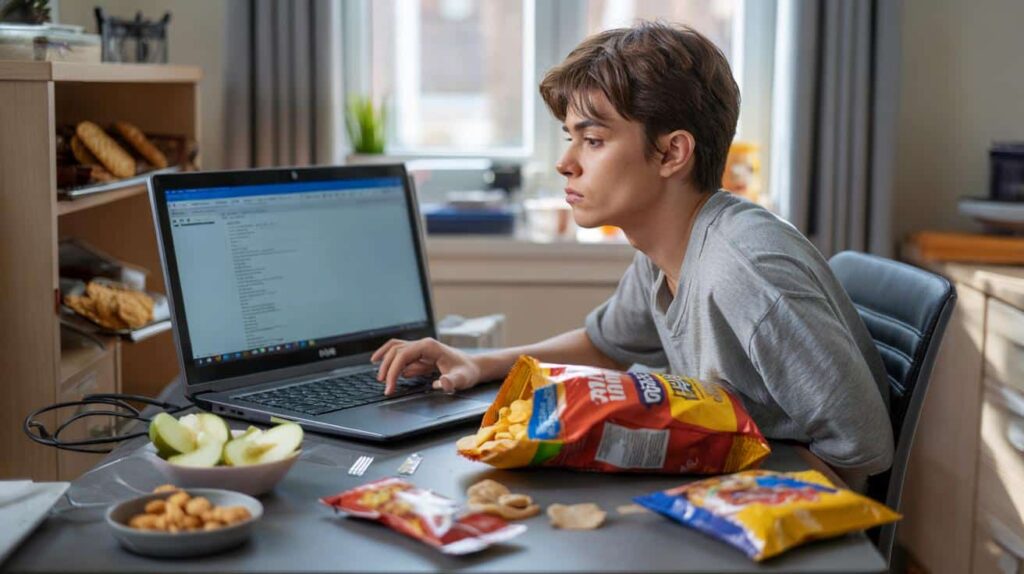
You’re not hungry.
You’re tired, slightly restless, waiting for the next thing to happen.
On the sofa, at your desk, during a Zoom meeting that should have been an email, it’s the same gesture: fingers searching for “something”. A crunch. A chew. A tiny spike of pleasure.
 A centenarian reveals the daily habits behind her long life, saying “I refuse to end up in care”
Then the familiar sting.
“Why am I eating again?”

That question is less about food than it looks.
When the snack replaces the feeling
Look around any open-plan office at 3:30 p.m. and you can almost hear the collective sigh.
The energy dips, attention leaks, and suddenly the shared snack drawer becomes the busiest spot in the building.
People don’t line up there with rumbling stomachs.
They show up because the spreadsheet is dull, their brain is fried, or the day feels endless.
The packet of cookies becomes a tiny escape hatch.
A few seconds where something actually happens.
One nutritionist I spoke to calls this “micro-escapes”.
Like the colleague who kept a jumbo bag of nuts on her desk and grazed all day, handful after handful, proudly saying, “At least it’s healthy.”
Except when she finally tracked it, she discovered she was eating the equivalent of two extra meals… while never really feeling full.
She wasn’t eating because her body was asking for fuel.
She was eating because she was bored, under-stimulated, and low-key stressed.
Her real hunger wasn’t in her stomach.
It was in her mind, begging for a different sensation than “meh”.
This mix-up between boredom and hunger happens fast because the signals look similar.
You feel an emptiness, a vague discomfort, a tug toward reward.
Your brain has a tried-and-tested shortcut: food equals a hit of dopamine, a quick mood lift, something to occupy your mouth and hands.
So it sends you to the kitchen instead of sending you out for a walk or toward a harder question: “What do I actually need right now?”
*The body whispers, the snack shouts.*
And most of the time, we follow whoever speaks louder.
How to tell if you’re really hungry
There is a tiny experiment you can run that takes less than one minute.
Next time you feel like grabbing a snack, pause and ask yourself: “Would a plain apple or a slice of bread sound good right now?”
If the answer is yes, chances are your body genuinely wants fuel.
If the answer is “No, I only want chocolate, salty crisps, or that specific cereal”, you might be chasing stimulation, not nourishment.
Real hunger is flexible.
Boredom hunger is picky, dramatic and oddly specific.
Another trick: check the clock and your body at the same time.
When did you last eat a real meal with protein, fat, and fibre?
If it’s been four or five hours and your stomach is quietly growling, that’s one story.
If you ate 45 minutes ago and you’re just restless in a meeting, that’s another.

We’ve all been there, that moment when you find yourself standing in front of the fridge, door open, staring at shelves like you’re waiting for a movie trailer.
That scene is rarely about hunger.
It’s about wanting something to break the monotony.
Let’s be honest: nobody really does this every single day.
No one perfectly checks their hunger scale or breathes mindfully before each biscuit.
Life is noisy, kids are yelling, deadlines are tight, and the cupboard is right there.
Yet learning to spot just one or two of your biggest “fake hunger” moments can already shift the story.
Maybe it’s those late-night Netflix snacks.
Maybe it’s your 4 p.m. email-break munching.
You don’t need a perfect system.
You just need one moment of clarity before the hand hits the packet.
Small rituals that break the snacking spell
One of the simplest moves is to change what you do in the first 60 seconds of the urge.
When you feel the need to snack, stand up, drink a glass of water, and walk to another room or the end of the corridor.
No phone. No scrolling. Just a small reset.
Then ask quietly: “Am I willing to wait ten minutes?”
If yes, set a timer and do something tiny but concrete: fold two pieces of laundry, answer one message, step outside the door.
If the hunger grows, eat. If it fades, you just met your boredom in person.
A lot of constant snackers make the same friendly mistake: they go “all or nothing”.
Either they decide they’ll never snack again, or they surrender completely and say, “That’s just who I am.”
Both extremes are exhausting.
A softer approach is to plan one or two intentional snacks a day and let the rest be a curiosity zone.
“Why did I want food right now?
What was I feeling three minutes before I opened the cupboard?”
Staying curious instead of guilty changes everything.
You’re not a weak person.
You’re a human whose brain loves easy rewards.
Sometimes the body isn’t asking, “Feed me,” it’s whispering, “Notice me.”
Food just happens to be the fastest way we’ve learned to respond.
- Keep “boring snacks” visible, fun treats less visible
- Eat actual meals with protein so your body isn’t running on fumes
- Create one non-food ritual for boredom: a song, a stretch, a short walk
- Use a small bowl instead of eating from the packet, even at home
- Once a week, gently note when you snacked from stress or habit
When snacking becomes a message, not a problem
People who snack constantly are often incredibly good at one thing: detecting tiny emotional dips.
The moment the day feels flat, lonely, or awkward, their radar goes off and their hand goes to the cupboard.
That reflex isn’t “bad”.
It’s just unfinished.
It’s like your inner system saying, “Something is off,” then hitting the wrong button.
What if every urge to snack was treated as a notification from your emotional life, not a moral failure?
A gentle ping asking, “Are you tired? Are you under-stimulated? Are you avoiding something hard?”

Sometimes, boredom is just your brain begging for a different kind of nourishment: human contact, sunlight, a challenge that actually excites you.

| Key point | Detail | Value for the reader |
|---|---|---|
| Spot boredom vs real hunger | Ask if plain food sounds appealing and notice timing since last meal | Reduces mindless snacking and confusion around appetite |
| Use 60-second rituals | Stand up, drink water, move, then wait ten minutes | Gives space to choose consciously instead of reacting |
| Turn snacking into a signal | See urges as messages about mood, stress or routine | Helps address root causes, not just the symptom |
FAQ:
- Question 1How do I know for sure if I’m actually hungry or just bored?
- Question 2Is it “bad” to snack in front of the TV every evening?
- Question 3What can I eat if I really like to chew on something while working?
- Question 4Why do I feel hungrier when I’m working from home than at the office?
- Question 5Can I fix constant snacking without going on a strict diet?
