
The message pinged into the group chat just after dawn: “School’s closed. Pipes burst. Stay home, stay warm.”
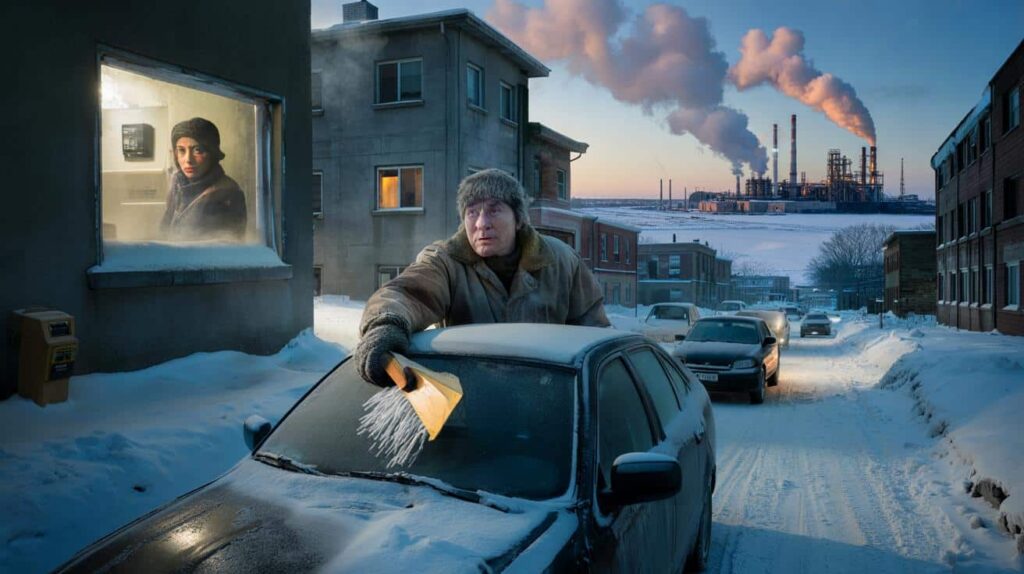
Outside, the street looked like a frozen screenshot. Cars half-buried. Breath turning into tiny clouds. A delivery driver scraped ice from his windshield with an old loyalty card, fingers bare, because he’d lost one glove last week and payday was still far away.
On the news, a smooth voice talked about a “historic polar vortex disruption,” all pastel graphics and satellite swirls.
No mention of the woman in a hallway coat, staring at her prepay meter running out of credit.
All the while, smoke kept rising from refineries and power plants, bright as ever against the white sky.

Something about that contrast feels impossible to unsee.

The polar vortex is wobbling, and ordinary people are in its path
High above our heads, around 30 kilometers up, the polar vortex is doing something it really shouldn’t be doing in February: breaking apart, stretching, buckling.
Scientists call it a “sudden stratospheric warming” event, when the air over the Arctic heats up dramatically and scrambles the usual wind patterns.
Down here, it doesn’t feel like a scientific term.
It feels like waking up to -20°C wind chills, record snow where there should be drizzle, and frozen sidewalks that turn a simple supermarket run into a small expedition.
The sky looks calm, but the atmosphere is out of joint.
You could see the first hints of what’s coming in the data long before you could feel it on your skin.
Meteorologists started whispering about a major disruption back in January: the polar vortex slowing, then splitting, pushing blocks of frigid Arctic air southwards like broken glass scattering across a table.
Now the models show those shards lining up over North America, parts of Europe, and chunks of Asia.
Regions that had a gentle, almost suspiciously mild winter are suddenly staring down warnings of “once in a decade” cold.
People who barely turned the heat on in December are now recharging gas cards in a panic.
The science is complicated, but the outline is painfully simple.
The Arctic has warmed at least four times faster than the rest of the planet, shrinking sea ice and changing how heat flows between ocean, land, and sky.
That kind of imbalance nudges the jet stream into lazy, wavy loops and leaves the polar vortex more vulnerable to dramatic disruptions.
Climate change doesn’t mean “no more cold,” it means “more extremes, more often, in stranger places.”
So while global temperatures break records, millions still get hammered by brutal cold created by the same destabilized system.
Who pays for the cold? Spoiler: not the ones who caused it
Look at any photo from a deep freeze and you’ll see the same faces on repeat.
The nurse doing an extra shift because winter viruses are spreading fast in overcrowded, under-heated homes.
The bus driver navigating black ice in a vehicle older than many of the passengers.
People use towels, tape, and blankets to seal windows against drafts.
Landlords shrug at burst pipes in low-income buildings while posting “supply chain issues” notices.
Meanwhile, energy companies send glossy winter “safety tips” emails that dance around the blunt truth of the bill total at the bottom.
During the 2021 Texas freeze, wholesale electricity prices jumped as high as 300 times normal, and some households received bills bigger than their monthly rent.
This time, energy traders are again circling the forecast like vultures around a weather map, speculating on gas futures with the calm of people who will never have to choose between heating and groceries.
At the same moment, major fossil fuel companies have been reporting record profits, driven by volatile markets their own products help inflame.
In some countries, governments lightly tax those windfalls.
In others, they don’t even bother with that gesture, letting dividends flow while families queue at charity stations for free space heaters and blankets.
The structure of the game is almost insultingly clear.
The emissions that destabilize the polar vortex are heavily concentrated among a small group of corporations and high-consumption economies.
Yet the people left to absorb the shockwaves are renters, gig workers, pensioners, students in under-heated dorms.
Climate models treat humanity as one neat number.
Real life doesn’t.
The cold does not land evenly: it finds cracked windows, old boilers, and bank accounts that were already in the red long before the forecast turned blue.
Staying warm in a broken system: practical steps, imperfect reality
When the wind bites and the headlines turn apocalyptic, survival gets unglamorous very fast.
Forget the Instagram winter aesthetic.
This is about layers, timing, and tiny hacks that shave a few degrees off the fear.

Start with your body, not the room.
Multiple thin layers trap more heat than one thick jumper.
Two pairs of socks and a hat indoors can make a cold home just about bearable, especially at night when your circulation slows.
If you can, pick one “warm room” and focus your limited heating there.
Close doors, hang a sheet or blanket over open archways, and move your main daily activities into that bubble.
It’s not stylish, but it keeps your core warm.
Most people know the theory of “preparing for a cold snap” and then life gets in the way.
Let’s be honest: nobody really does this every single day.
So start from where you are, not from some ideal prepper checklist.
Bleed radiators if you can.
Check for obvious drafts with the back of your hand and block them with whatever you’ve got: old towels, cardboard, junk mail stuffed into gaps.
If you’re on a prepay meter, top up earlier in the day if possible.
Running out of credit at 2 a.m. in a deep freeze is not just uncomfortable, it can be dangerous for kids, older relatives, or anyone with health conditions.
Talk honestly with neighbours or friends; sharing a kettle, an extension cord, or even a couch for the night is not weakness, it’s community.
Sometimes the bravest sentence in a cold snap is, “I’m not coping, can I come over?”
- Check local “warm spaces” or community centers. Many towns quietly open heated rooms, libraries, or churches during extreme cold.
- Keep a small “heat kit” by the bed: socks, hat, extra blanket, a charged phone, and any medication.
- Rotate hot water bottles or warmed rice socks between people in the house, especially children and elderly relatives.
- Watch for warning signs of hypothermia: confusion, slurred speech, shivering that suddenly stops, or unusually cold skin.
- Save emergency numbers somewhere physical, not just in your phone. Technology fails, paper doesn’t run out of battery.
The anger under the frost: from private struggle to public story
There’s a very quiet kind of rage that rises on days like this.
You watch your breath fog in your own living room while seeing flares from oil refineries burning bright in the distance, untouched by the storm they helped summon.
We’ve all been there, that moment when the weather forecast becomes personal: not “minus 15” on a screen, but the feeling of your fingers going numb at the bus stop while the app cheerfully calls it “feels like -22.”
The temptation is to frame it as bad luck, a tough winter, a cruel twist of nature.
Yet deep down most of us know this isn’t just a fluke.
*The dice were loaded long before this cold front rolled in.*
What happens next isn’t just about this one polar vortex disruption.
It’s about whether these extremes remain isolated “events” or become evidence in a much larger social argument.
Some cities are slowly moving toward ideas that used to sound radical: fines for energy companies that overcharge during weather emergencies, insulated social housing as a right, “climate damages” funds paid by the biggest historic emitters.
Others double down on short-term fixes, shoveling public money into temporary fuel subsidies while fresh drilling licences are quietly approved in the background.
The cold doesn’t care which path your government picks.
But your chances of facing the next disruption without fear absolutely depend on it.
For now, ordinary people do what they always do.
They tape the windows.
They share blankets.
They send each other screenshots of weather maps along with nervous jokes.
Some will organize: tenants’ unions pushing for proper insulation, local campaigns for warm hubs, online pressure on companies that profit from crisis.
Some will simply hold on until the thaw, because survival leaves little energy for activism.

This February’s polar vortex disruption won’t be the last.
Whether it goes down in memory as just another “historic” cold spell or as a turning point in how we talk about climate responsibility depends on what we dare to say out loud, in the shivering hours between now and spring.
| Key point | Detail | Value for the reader |
|---|---|---|
| Polar vortex disruption | Arctic warming destabilizes high-altitude winds, sending extreme cold south | Helps you understand why “global warming” can still bring brutal winter blasts |
| Unequal impact | Low-income households face the highest risk from energy prices and poor housing | Gives context to personal hardship and shows it’s not just “bad luck” |
| Practical response | Layering, warm-room strategy, community support, and recognizing danger signs | Concrete steps to stay safer and slightly more in control during the freeze |
FAQ:
- Question 1Is this polar vortex disruption caused by climate change?Scientists are cautious about blaming any single event, but many studies suggest that rapid Arctic warming can weaken and destabilize the polar vortex. That makes these large disruptions more likely and sometimes more intense.
- Question 2Why are we getting extreme cold if the planet is warming overall?Global warming raises the average temperature, yet it also disrupts long-standing circulation patterns. That disruption can send pockets of polar air much further south than before, creating short, violent cold spells in a generally warming world.
- Question 3Who are the “big polluters” people talk about?A relatively small number of fossil fuel companies and heavy industries account for a large share of historical greenhouse gas emissions. Their operations, plus continued investment in oil, gas, and coal, drive much of the long-term warming trend behind these extremes.
- Question 4What can I realistically do to stay warm if money is tight?Focus on insulating one room, layering clothing, sealing obvious drafts, and using shared resources like community warm spaces. Talk to local charities, housing organizations, or advice services, which sometimes have emergency support for heating or electric bills.
- Question 5Is there any point in individual action when companies pollute so much?Personal action won’t fix the system on its own, but it matters when it connects with others. Voting, joining local campaigns, supporting tenants’ and workers’ groups, and pushing for stronger climate and housing policies all help shift the rules that let big polluters walk away untouched.
