
The first time I noticed it was in the grocery store line. My shoulders were somewhere near my ears, my jaw felt locked, and my heart was thudding like I’d sprinted, even though I’d just been standing still. No big drama, no crisis. Just a Tuesday. I looked around and saw the same thing on other faces: rushed, tight, on the verge of “too much” for no clear reason.
Then I caught my reflection in the freezer door. My chest was barely moving. I realized I hadn’t truly breathed in what felt like ages. Not the shallow sips of air we take while scrolling, but a real breath.
One small thing changed that day. And it never took more than a minute.
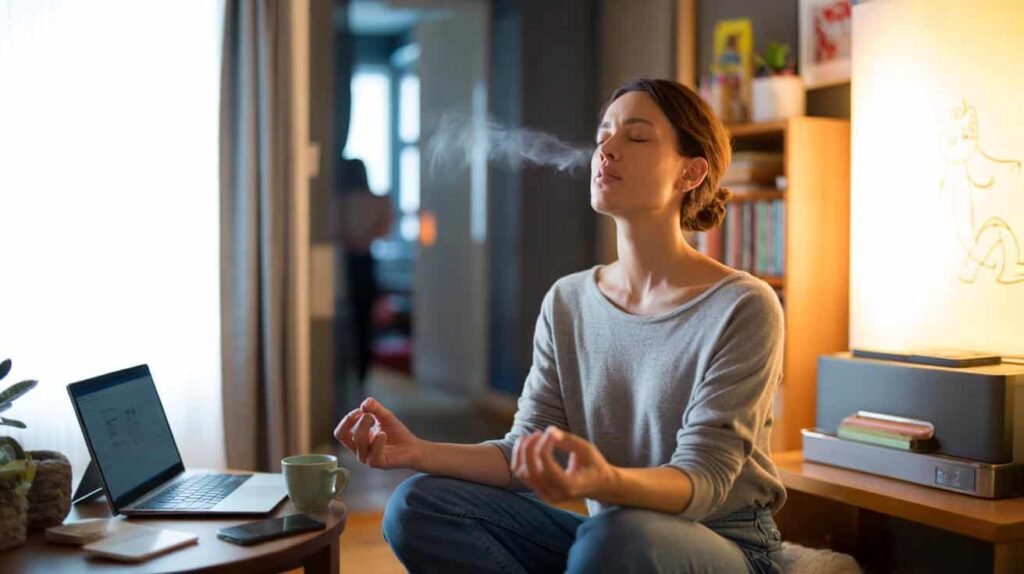
The tiny daily reset your nervous system is begging for
There’s a habit so small it almost feels insulting to call it “wellness.” It doesn’t require apps, equipment, special clothes, or a morning routine worthy of Instagram. You can do it in the kitchen, in a meeting, or in the bathroom with the door locked for 60 seconds.
It’s simply this: once a day, stop and take five slow, deliberate breaths where the exhale is longer than the inhale. That’s it. No candles. No complicated protocol.
Done consistently, this almost invisible practice quietly starts to reorganize your body from the inside.
A friend of mine, Lea, started this by accident. She’s a nurse, constantly on her feet, swallowing her stress between patients. One afternoon she ducked into an empty supply room, leaned on a shelf, and counted out five long breaths just so she wouldn’t snap at anyone.
She did the same thing the next day. And the next. After a week, she noticed something odd: she still had long shifts and intense days, but her inner “shakiness” was down a notch. Her hands didn’t tremble when she finally sat to eat. Her sleep stopped feeling like a battle.
Nothing about her life was calmer. Her body was.

This tiny habit works because it talks directly to the part of you that doesn’t understand words: your nervous system. Long exhales signal safety to the vagus nerve, the main line in your body’s calm-down network. Your heart rate eases, your muscles unclench, digestion gets the green light again.
You’re not “thinking” your way into balance, you’re breathing your way there. That’s a big difference.
*When the body feels even slightly safer, the mind finally gets a chance to catch up.*

How to do the 5-breath reset so it actually sticks
Here’s the simplest version. Pick one anchor in your day: brushing your teeth at night, closing your laptop, sitting in the car before driving off. Pair it with this micro-ritual.
Breathe in gently through your nose for a count of four. Hold for one beat. Then exhale through pursed lips for a count of six. Repeat this five times.
If counting stresses you out, just “feel” it instead: easy inhale, slightly slower exhale, like you’re fogging up a window in winter. The key is that longer out-breath, not perfection.

The biggest trap is turning this into another performance goal. The moment you tell yourself, “I must do this every day or I’ve failed,” the habit starts to rot. Life happens, kids wake up early, meetings go late, the bus is missed.
Let’s be honest: nobody really does this every single day. And that’s okay.
Treat it like a friendly reset button you can press when you remember, not a test you’re constantly flunking. Your body responds to “often enough,” not “perfect score.”
“Every time I do my five breaths, it feels like I’m turning the volume down one notch,” Lea told me. “The noise is still there, but suddenly I can hear myself again.”

- Link it to something you already do (coffee, commute, skincare) so you don’t rely on willpower.
- Keep it short: five breaths, not fifteen minutes, or you’ll skip it on busy days.
- Accept messy versions: standing in line, kids yelling, phone buzzing. It still counts.
- Use it as a pause before reacting: email reply, tough text, difficult conversation.
- Notice one body change each time (warmer hands, softer jaw, slower heartbeat) to reinforce the habit.
When a tiny ritual becomes a quiet form of self-respect
There’s something strangely moving about realizing you can give your body a sense of “I’ve got you” in under a minute. No grand resolutions, no reinvention of your personality, just a modest daily gesture that says: you’re not a machine.
Over weeks, people who practice this kind of breathing often report the same subtle shifts. They don’t snap as fast. They digest a little better. Afternoon crashes ease. The day still brings chaos, but their inner balance wobbles instead of shattering.
We’ve all been there, that moment when you suddenly notice you’ve been clenching your teeth for hours. A five-breath reset won’t fix the world. Yet it often gives just enough space to choose your next move instead of being dragged by it.

| Key point | Detail | Value for the reader |
|---|---|---|
| Longer exhale breathing | Five breaths with a slightly longer out-breath calms the nervous system | Quick, discreet way to feel more grounded during stressful days |
| Anchor to daily routines | Pair the habit with teeth brushing, commuting, or shutdown time | Makes the practice automatic and easier to maintain over time |
| “Good enough” mindset | Focus on consistency, not perfection or strict rules | Reduces guilt and keeps the habit sustainable in real life |
FAQ:
- Question 1How long does it take for this breathing habit to start working?Some people feel a small shift – like a tiny softening in the chest – on the very first try. For deeper changes, such as better sleep or reduced tension, give it 2–3 weeks of fairly regular practice.
- Question 2Can I do more than five breaths if I have time?Yes, you can extend it to 10 or even 20 breaths if it feels good. Start with five so it’s easy to keep doing on busy days, then stretch the ritual when life allows.
- Question 3Is this the same as meditation?Not exactly. This is more like a nervous-system reset button than a full meditation. You’re using your breath as a physical lever to nudge your body toward balance, without needing to “empty your mind.”
- Question 4What if focusing on my breath makes me anxious?If that happens, try focusing on the feeling of your feet on the floor while you breathe, or look at a fixed point in the room. You can also shorten the practice to three breaths and build up slowly.
- Question 5Will this replace exercise, therapy, or medical treatment?No, this habit is a support, not a substitute. Think of it as one simple tool in your toolkit that sits alongside movement, rest, connection, and professional care when needed.
