
By 8:47 p.m., the day already felt like a bad draft. The inbox still buzzing in my head, the half-folded laundry staring from the chair, that one unresolved message sitting “seen” but unanswered. The sky outside the kitchen window had turned into that dull blue-grey that makes you think of unfinished conversations and missed calls.
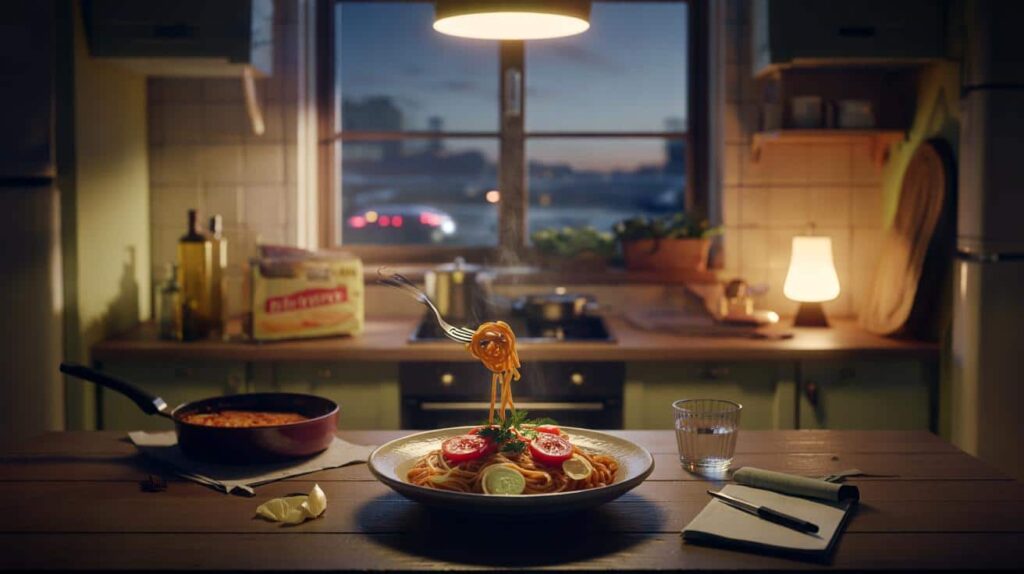
So I did the one thing that made sense: I opened the fridge.
A limp bunch of parsley. The end of a block of Parmesan. Two tomatoes, a little wrinkled but still hanging on. And in the cupboard, a familiar promise: a box of pasta. I put the pot on, turned up the gas, and decided that this bowl would be my full stop to the day.

The water started to boil, and I could feel my shoulders drop.
Something inside me was already closing.

The dish that turns a messy day into a finished story
Some days, dinner is not about nutrients or presentation. It’s about putting a period at the end of a long, run-on sentence of hours. You stand there at the stove, stirring something simple, and suddenly the whole day starts to quiet down.
For me, that dish is a quick tomato-garlic pasta. Olive oil, sliced garlic just beginning to sing in the pan, chopped tomatoes that melt down into a rough, lazy sauce. A pinch of salt, a small spoon of sugar, the heat turned low. It’s nothing fancy, yet it smells like someone finally pressed “save” on the day.
By the time the pasta hits the sauce, the chaos of the last ten hours feels less sharp. The kitchen light is warm. The timeline slows.
Not long ago, a friend told me about her own “closure dish.” She’s a nurse, so her days don’t end at 5 p.m. They end when they end, often late, often heavy. On the nights that feel like too much, she doesn’t scroll, doesn’t pour a drink. She peels potatoes.
She makes a small pan of crisp, golden potatoes with butter and rosemary. No special recipe. Just cubes, salt, sizzling edges. She eats them standing at the counter, sometimes in silence, sometimes with a podcast softly playing behind her. “That’s when my shift really ends,” she said. “Not at the hospital doors. At the pan.”
We don’t always talk about this secret category of recipes. The ones that aren’t for guests, or for Instagram, but for returning to yourself.
There’s a reason a simple, repetitive cooking ritual can feel like closing tabs in your brain. Your hands know exactly what to do, which gives your mind permission to stop performing. Chopping onions, rinsing rice, tasting for salt — these are small, clear tasks with beginnings and endings.
All day, most of what we do is abstract: emails, numbers, notifications, vague future goals. At the stove, everything is concrete again. Pasta is undercooked, cooked, or overcooked. Bread is raw or golden. You add heat and time, and something changes in a visible, understandable way.
*Cooking a familiar dish gives your tired brain the comfort of cause and effect.* You stir, something thickens. You wait, something browns. That’s closure in its most physical form.

Turning “what’s for dinner?” into a nightly ritual of closure
If you want that sense of closure, the dish itself doesn’t need to be impressive. What matters is repetition. Pick one recipe that you can almost cook with your eyes closed, and let it become your “the day ends here” ritual.
Maybe it’s eggs on toast with too much butter and a little cheese. Maybe it’s a bowl of rice with soy sauce, sesame oil, and a fried egg. Maybe it’s a quick veggie stir-fry, always with the same sauce: garlic, ginger, soy, a touch of honey. The key is that you don’t have to think too hard.
Light a small lamp, put your phone in another room, and let the steps unfold in the same order. Water. Heat. Sizzle. Plate. By the time you sit down, you’re not just feeding hunger. You’re closing the book on the day.
The trap is turning this gentle ritual into yet another performance or obligation. That’s when it stops helping and starts piling on guilt. We’ve all been there, that moment when you’re too exhausted to cook and you feel like you’ve “failed” some imaginary standard.
Let’s be honest: nobody really does this every single day. Some nights will be all about delivery apps and leftover cereal, and that’s part of real life. The closure dish is an option, not a rule. A soft place to land, not a bar to reach.
If cooking feels like pressure, shrink the ritual. Maybe your nightly closure is just boiling water for tea and buttering a slice of bread. The point is the pause and the gesture, not the complexity.
On one particularly heavy Tuesday, I burned the garlic, overcooked the pasta, and almost gave up.
I ate it anyway.
And still, weirdly, I felt better.
“The dish doesn’t have to be perfect,” I wrote in my notebook afterwards, “it just has to be finished.”
- Keep one “closure” ingredient
Always stocked, always waiting: pasta, rice, eggs, or potatoes. Your ritual starts with having that anchor. - Repeat the same small steps
Same pan, same knife, same bowl. Repetition turns dinner into a calming ritual, not another decision. - Use tiny sensory anchors
A specific song, a lamp you only switch on at night, a towel over your shoulder. They quietly signal: “The day is ending now.”
When a plate becomes a quiet full stop
The night I really understood all this, I was eating alone at my small kitchen table. Outside, the street was humming with late buses and distant sirens. My pasta was a little too salty, the Parmesan not as generous as I would’ve liked. Still, as I twirled the last forkful, I felt something loosen inside my chest.
The emails were still unanswered. The laundry still slumped. The unanswered message was still unanswered. Those problems didn’t magically disappear. Yet the day felt finished in a way it hadn’t half an hour earlier. The cooking, the eating, the dishes left to dry — they formed a simple arc with a beginning, a middle and an end.
 Goodbye kitchen cabinets: the cheaper new trend that won’t warp, swell, or go mouldy over time
Maybe that’s what we’re really hungry for when we stand in front of the fridge at 8:47 p.m. Not just food, but a way to say: “This day happened. And now it’s over.” A pan, a plate, and a few quiet minutes might just be enough to draw that invisible line in the sand, and step over it.

| Key point | Detail | Value for the reader |
|---|---|---|
| Choose a “closure dish” | One simple, repeatable recipe you can make on autopilot | Reduces decision fatigue and signals the end of the day |
| Focus on ritual, not perfection | Same steps, same tools, low pressure, no performance | Turns cooking into a calming anchor instead of a chore |
| Use sensory cues | Light, sound, smell linked to your nightly dish | Helps your body and mind gently shift into evening mode |
FAQ:
- What if I don’t like cooking but still want that sense of closure?
Pick something extremely simple: toasting bread, assembling a yogurt bowl, or making tea with a small snack. The ritual matters more than the recipe.- Can my closure dish be something store-bought or frozen?
Yes. Heating the same soup, baking the same frozen pizza, or plating the same snacks can still become a grounding nightly pattern.- Is it bad if my closure dish is “unhealthy”?
A comforting grilled cheese or bowl of instant noodles can absolutely be part of this. If you’re worried, you can always balance it with lighter meals earlier in the day.- What if my schedule is chaotic and I eat at different times?
Your closure dish doesn’t have to happen at a fixed hour. It’s more about choosing a moment — whenever your day truly ends — and repeating the same small ritual then.- Can I share this ritual with someone else?
Definitely. Cooking the same simple dish together at night can become a shared signal that “we made it through today,” even if everything else felt scattered.
