At first glance, my apartment didn’t look like a disaster. The kind of place you can photograph cleverly, from one angle, and fool Instagram. But if you opened a random drawer or glanced at the chair near the door, you’d see the truth: half-folded laundry, unopened mail, too many tote bags for one human life.
I used to tell myself the same line every night: “I’m just too busy, I don’t have time to tidy.” Then I’d scroll for 40 minutes in bed, surrounded by the mess I blamed on my calendar.
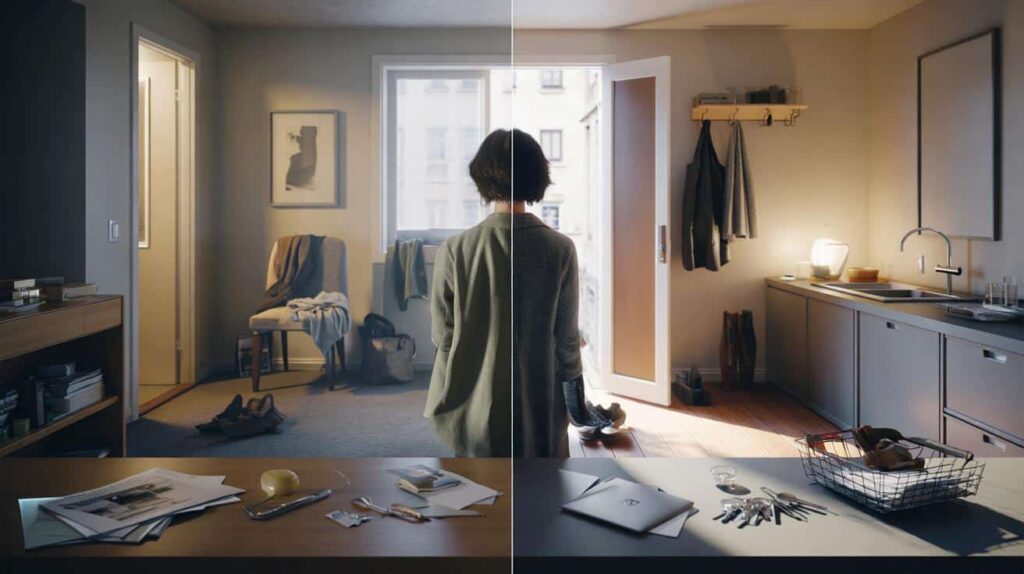
One day, a very small, very stupid incident cracked that story in half.
And I haven’t been able to unsee it since.

When “no time” is just a very convincing story
The breaking point came on a Tuesday morning, around 8:12 a.m., with a missing AirPod.
I was already late, coffee in one hand, laptop bag in the other, when I realized the left earbud had vanished somewhere into the chaos of my living room. Cushions were half off the couch from last night’s Netflix session, tote bags piled on the chair, yesterday’s jeans abandoned in the hallway.

I froze in the middle of it all, looking at my own mess like it belonged to a stranger.
This wasn’t “no time”.
This was a series of tiny delays I had created myself.
I did that panicked shuffle we all do.
Lifted a cushion, shook a blanket, checked pockets I’d already checked. The clock kept moving.
By the time I found the AirPod — wedged under a magazine that had been on the floor for a week — I had lost 11 minutes and any hope of arriving on time.
Walking to the subway, it hit me in a very non-philosophical, very boring way: my mess was literally stealing minutes from my life. Not hours. Not some theoretical “productivity”. Actual, countable minutes.
The punchline? I had spent those same 11 minutes the night before arguing with myself that I was “too tired to put things away”.
So the time existed.
I had just traded it.
That day I started quietly tracking the time my mess cost me. The extra 4 minutes hunting for keys. The 7 minutes reprinting a document I lost in a paper pile. The 3 minutes trying to remember which bag held my charger.
Over a week, I realized I wasn’t short on time. I was paying a hidden “clutter tax” — small, annoying, interest-compounding fees on every object that didn’t have a home.
The logic was brutal and simple.
Mess doesn’t only come from a lack of time. It also comes from a lack of decisions.
Every item left “for later” was a decision I postponed, one I had to pay for twice: once when I dropped it, and again when I went back to rescue it.
The tiny-rule shift that changed everything
I didn’t start with a huge clean-out. No trash bags, no dramatic “before/after” transformation.
What changed things was a rule I stole, twisted, and made my own: if something takes less than 60 seconds to put away, I do it immediately.
Not 5 minutes. Sixty seconds. One song beat, two emails, a very quick scroll.
Coat on a chair? Hang it now.
Empty glass on the coffee table? Into the sink.
Shoes near the couch? Back to the entrance.
The rule was stupidly small, but it began to rewind the movie of my day. I wasn’t “cleaning the house”. I was just closing loops that had been left open all over my space.
Of course, my brain resisted at first.
There were nights I’d look at the kitchen counter and hear the old script: “You’re tired. You can do that tomorrow.”
That’s where the emotional bit shows up. Mess isn’t only about objects, it’s about the little negotiations we have with ourselves when nobody’s watching.
I started talking back to that voice like it was a slightly lazy roommate. “You’re not tired, you’re scrolling.”
Let’s be honest: nobody really does this every single day.
There are still evenings when the chair near my door collects a bag, a coat, and a scarf. The difference now is that I recognize the cost. I can *feel* the future version of me paying for tonight’s decision.
One sentence opened my eyes and hasn’t left my head since:
“You don’t rise to the level of your goals, you fall to the level of your systems.” — James Clear
My “system” used to be: drop stuff wherever, complain about time later.

I rewired it with three simple defaults:
- One-touch rule: If I pick something up, it goes directly where it belongs, not to a “temporary” surface.
- Visible homes only: Every daily object gets a clear, obvious place, not a mystery drawer I’ll forget.
- Night reset: Five-minute sweep before bed, no perfection, just removing the worst of the visual noise.
None of this turned me into a minimalist.
It just turned my space from a time thief into something closer to an ally.
When mess stops being moral, and starts being practical
The biggest shift wasn’t visual, it was mental. I stopped treating mess as a moral failure — “you’re lazy, you can’t organize” — and started treating it like a logistics problem.
If my keys kept disappearing, it wasn’t a sign that I was chaotic by nature. It meant my key storage system was stupid.
I moved the key hook to the exact spot where my hand naturally dropped my bag when I walked in. Suddenly, I wasn’t fighting my habits, I was upgrading them.
Once I understood that, the guilt began to loosen its grip.
I also stopped aiming for “tidy house” as a giant, fuzzy goal.
That phrase is paralyzing.
Instead, I broke it into ridiculous micro-actions: clear just the coffee table, empty just the bag I used today, file only today’s mail pile.
The trap many of us fall into is the all-or-nothing cleaning marathon. We wait until the mess becomes unbearable, then spend a whole Sunday scrubbing, swearing we’ll change. Then life happens, the system collapses, and shame creeps back in.
I started asking a softer question at random times: “What’s the smallest thing I can reset in the next two minutes?”
Not heroic, not Instagrammable. Just practical.
We’ve all been there, that moment when you say, “Tomorrow I’ll get my life together,” while stepping over a pair of shoes that haven’t moved in three days.
The plain truth is: mess isn’t about time, it’s about friction.
If putting something away is even slightly annoying — if the box is too high, the drawer is full, the closet is jammed — our brain will always vote for “later”.
So the real work is lowering friction:
- Fewer steps between “in my hand” and “in its place”.
- Storage that matches how you actually live, not how a Pinterest board looks.
- Spaces that are good enough, not museum-level perfect.
When I focused on that, my space started staying “just tidy enough” without drama.
And that was the breakthrough I didn’t see coming.
| Key point | Detail | Value for the reader |
|---|---|---|
| Mess costs real time | Clutter creates a hidden “tax” in lost minutes searching, redoing, and delaying | Makes you see your space less as “ugly” and more as a practical time issue you can change |
| Systems beat willpower | Small rules like the 60-second rule or one-touch rule reduce decisions and resistance | Gives simple habits you can apply today without a big clean-out or new products |
| Lower friction, not standards | Move storage to where you naturally drop things, aim for “good enough” order | Helps you keep a livable space consistently, not just after rare cleaning marathons |
FAQ:
- Question 1What if I genuinely have a very busy schedule and feel I can’t start?
- Answer 1
Start with one tiny surface you see every day — a nightstand, a desk corner, a kitchen spot. Give yourself three minutes, not more. You’re not “cleaning the house”, you’re running a quick experiment to prove you can create one pocket of order without needing a free evening.
- Question 2How do I stop the chair from becoming a clothes mountain?
- Answer 2
Give “in-between” clothes a specific home that isn’t the chair: a single hook, one basket, or a small rail. Limit it to a fixed number of items. When it’s full, something has to go to the closet or the laundry. The chair isn’t the problem, the lack of a middle-ground spot is.
- Question 3What if my partner or housemates are messier than I am?
- Answer 3
Pick shared zones you both care about — the sofa, dining table, bathroom counter — and agree on minimal rules there only. Start with one shared habit, like a two-minute reset after dinner. You can’t control their entire behavior, only co-design a few “no-mess islands”.
- Question 4I declutter, but the mess comes back. What am I doing wrong?
- Answer 4
Decluttering without changing the daily system is like deleting emails without unsubscribing. Look at where mess returns first: that’s a system failure, not a character flaw. Adjust storage, reduce the number of things in that category, or move the “home” closer to where you use the item.
Also readGoodbye kitchen cabinets: the cheaper new trend that won’t warp, swell, or go mouldy over time
- Question 5How do I stay motivated when progress feels slow?
- Answer 5
Track wins you usually ignore: “no frantic key search this week”, “kitchen counter visible three days in a row”. Take quick before/after photos of small areas. Tiny visible proof is what keeps your brain invested long after the initial enthusiasm fades.