
At 7:15 a.m. sharp, the kettle whistles in a small terraced house at the edge of town. A woman in a blue cardigan leans on the counter, stretches her back and laughs to herself when her knee clicks. “Old hinge,” she says. On the table: a perfectly sliced apple, a boiled egg, and a handwritten list titled “Today I move.” The handwriting looks shaky at first glance. Then you notice the loops are firm, almost stubborn.
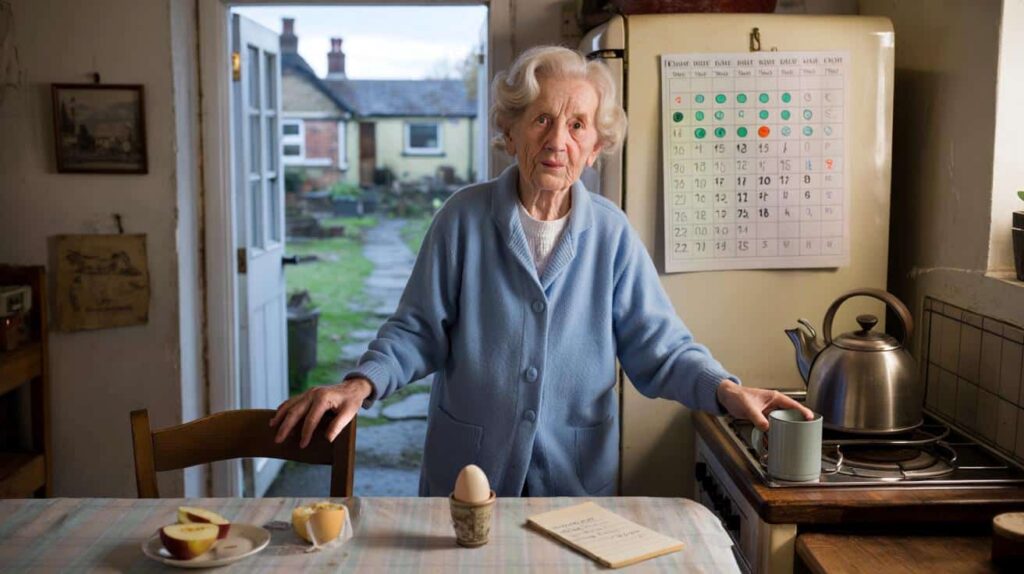
Her name is Joan, she’s 100 years old, and she has one fixed rule: she refuses to end up in care. Friends her age have been moved into homes, their routines swallowed by visiting hours and medication rounds. Joan tightens the belt on her housecoat and opens the back door to the garden.
“Long life isn’t luck,” she says. “It’s what you repeat when nobody’s watching.”

The centenarian who plans her freedom, one tiny habit at a time
The first thing you notice about Joan isn’t her age. It’s the way she moves with a kind of deliberate slowness, like someone who’s decided not to rush but refuses to rust. Her frame is small, her hands veined, yet there’s a quiet energy to the way she carries her grocery basket, counts her steps out loud, and wipes down the kitchen counter herself.
She lives alone, in the same house she bought with her late husband in the 1960s. Neighbours have gently suggested “extra help.” Her doctor has floated the idea of a care home “for later.” Joan nods, smiles, and goes home to do her morning stretches by the armchair.
Her goal isn’t to be forever young. Her goal is simple: stay in charge of her own day.
On the wall next to her fridge hangs a calendar with three coloured dots scribbled on almost every date. Green for “walked outside.” Orange for “cooked from scratch.” Blue for “saw or phoned someone.” She taps a cluster of green and smiles. “December was a good month,” she says. “Snow tried to stop me. I told it no.”
Her walk is not glamorous. Up the street, down the street, to the bench by the bus stop, and back again. Sometimes it’s ten minutes. On braver days, twenty. When her legs ache, she leans on a low wall, waits, and then keeps going.
We’ve all been there, that moment when your body offers you an excuse to give up. Joan’s trick is to bargain: “Just to the next lamppost. Then you can stop.” By the time she reaches it, she’s already decided to go to the next one.
What looks like stubbornness is actually a system. Joan’s daily habits are less about chasing health trends and more about protecting three things: movement, clarity, and dignity. She doesn’t do hour-long gym sessions or carefully calibrated smoothie diets. She protects the basics.
She moves her body several times a day, even if it’s just marching on the spot while the kettle boils. She eats simple meals she can prepare safely on her own. She keeps her brain working with crosswords, TV quiz shows and gossip with the neighbour’s daughter.
The logic is brutal and clear: the less she outsources, the longer she stays at home. “You stop doing things,” she says, “people take them off you forever.” That’s her real fear, far more than wrinkles or birthdays with three digits.
Her daily rules for never becoming “a passenger” in her own life
Each morning, before she even gets dressed, Joan does what she calls her “silly little circuit.” She grips the back of a sturdy chair, lifts her heels up and down twenty times, then slowly sits and stands from the same chair, arms crossed over her chest. It looks almost too simple. For her, it’s the line between independence and needing someone to help her off the toilet.

Then comes the practical check: she opens and closes her hands, rotates her wrists, shrugs her shoulders. If something twinges, she notes it out loud but keeps moving gently around it. “If I lie down every time something hurts, I’ll never get up again,” she shrugs.
Her mantra is short: “Use it, or lose it.” For a century-old woman, those four words are less slogan and more survival code.
Joan knows she doesn’t live in a fantasy. She’s had falls. She’s lost friends. There are days when she stares at her walking shoes and would rather stay in her dressing gown. She admits she used to wait for “motivation” to appear. It rarely did. Now she leans on routine, not enthusiasm.
Let’s be honest: nobody really does this every single day. She has lazy days, too. The difference is that she treats them as pauses, not new normal. The next morning, the kettle goes on, the chair gets pulled out, and she starts again, even if it’s slower.
What really drains older people, she says, isn’t age itself. It’s the gradual handing over of every small task: carrying a plate, tying shoelaces, walking to the corner shop. “People fuss,” she says kindly. “They think they’re helping. Sometimes they’re quietly taking away your last bit of power.”
“Everyone says they don’t want to end up in care,” Joan tells me, sliding her shopping list into her pocket. “But then they live like passengers and let other people drive. I won’t. As long as I can wash my own mug, I’m staying here.”
Her approach boils down to a few daily non‑negotiables, scribbled on a notepad by the phone:
- Move on purpose at least three times a day – morning circuit, short walk, evening stretch by the sink.
- Eat “real food you can recognise” – porridge, eggs, vegetables, stews, fruit, not a parade of ultra‑processed snacks.
- Keep your hands useful – peeling potatoes, folding laundry, writing cards, anything that avoids idle scrolling or endless TV.
- Talk to at least one person
- Refuse help you don’t truly need – to stay practiced at the things that keep you living on your own.
She doesn’t call this a longevity plan. She calls it “how not to slide without noticing.”
A long life that still feels like your own
Watching Joan shuffle down the street with her canvas bag, you might not guess she’s carrying a quiet revolution in that soft‑lined face. She’s not trying to be an influencer, she’s not selling a miracle regime, and she doesn’t pretend her way will work for every body or every illness. She just refuses the idea that age automatically equals being parked in an institution, waiting for visiting hours.
Her story raises awkward questions. Not everyone has a safe home, or supportive neighbours, or the kind of health that allows daily walks at 100. Many families rely on care homes out of sheer exhaustion or lack of choice. Still, inside those constraints, there is that small band of space we actually control each day. What we eat. How often we get up from the chair. Whether we let people do everything for us, or gently say, “No, I’ve got this one.”
 Meteorologists warn February may open with an Arctic shift scientists are struggling to model
Maybe the real inspiration isn’t that Joan reached 100. It’s that she still circles the date on the calendar, plans her own meals, and argues with the world on her own doorstep. A long life is one thing. A long life that still feels like your own is something else entirely.
| Key point | Detail | Value for the reader |
|---|---|---|
| Daily movement “circuit” | Simple chair exercises, short walks, repeated most days | Shows how small, realistic habits can protect strength and balance |
| Protecting small tasks | Insists on making her own tea, washing her mug, carrying light shopping | Illustrates how keeping everyday actions delays dependence on others |
| Routine over motivation | Relies on rituals and visual cues like coloured dots on a calendar | Helps readers design sustainable habits instead of waiting to “feel like it” |
FAQ:
- Question 1Are habits like Joan’s really more valuable than good genes for living a long life?Most researchers agree that genetics matter, but lifestyle and environment account for a large share of how we age. Daily movement, social contact and simple, unprocessed food can offset some of what your genes handed you.
- Question 2What’s one realistic habit to copy if I’m already quite sedentary?Start with getting up from a sturdy chair ten times in a row, once or twice a day. Add a very short daily walk, even if it’s just to the end of the street and back, and treat those as appointments.
- Question 3How does refusing certain kinds of help keep someone independent for longer?When you stop doing a task, you slowly lose the strength, balance or confidence for it. By still doing what she safely can, Joan keeps those muscles and skills “in practice”.
- Question 4Is it too late to start these habits if I’m already in my 70s or 80s?Evidence from rehab and fall‑prevention programs suggests that strength, balance and mood can improve at any age with gentle, consistent practice. The gains may be smaller, but they’re still meaningful.
- Question 5What if my health problems mean I genuinely can’t live alone at 100?Care settings can still include elements of Joan’s approach: choosing your own clothes, walking short distances instead of being wheeled everywhere, keeping a small routine you control each day.
