
It started with the kind of silence you only notice in winter. No wind, no birdsong, just a grey sky pressed low over the neighborhood, as if it was thinking about something. A woman on the corner struggled with a frozen car door, breath hanging in the air like smoke. The local radio played in the background from a garage, the host sounding oddly serious as he talked about “early February” and “Arctic breakdown scenarios.”
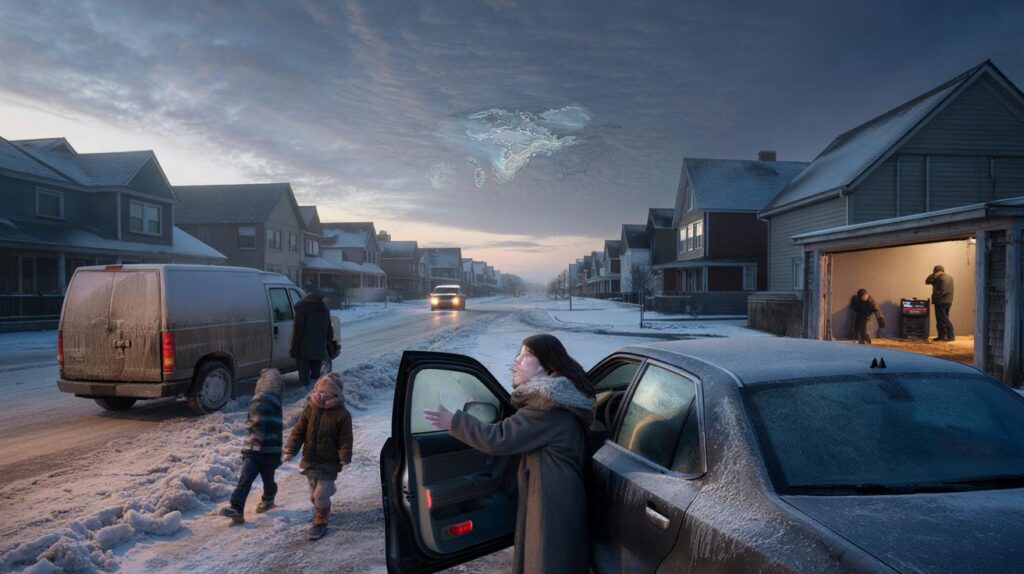
Nobody paused to listen. Kids still kicked slush at each other on the way to school. Delivery vans still rolled by, tires crunching over old snow. Yet the words hung there, colder than the air itself: a risky pattern, a potential plunge, a hint that the real winter hadn’t arrived yet.
Something in the season feels… off.

What meteorologists really mean by a “high risk Arctic breakdown”
When forecasters talk about a high risk Arctic breakdown in early February, they’re not just trying to scare you. They’re describing a fragile balance in the atmosphere that can suddenly collapse, letting brutally cold polar air spill far south. Picture the Arctic as a ceiling of cold, normally held in place by a sturdy spinning top of winds high above the pole. If that spinning weakens or wobbles, cracks open. And through those cracks, the deep freeze escapes.

For much of this winter, that top — the polar vortex — has been behaving strangely. Meteorologists watching upper-air maps say the pattern looks “loaded,” like a spring pulled back and waiting to snap.
You can already see the hints on the ground if you know where to look. A farmer in Minnesota told his local TV station that the soil never really hardened the way it usually does, then suddenly locked solid after one sharp night. In the UK, commuters have been bouncing between weeks of soggy, windy mildness and sudden icy mornings that glaze pavements in hours.
Last week, a weather service in Scandinavia went viral after sharing a temperature map: orange and red above the Arctic Circle, pale blues and purples creeping over central Europe and North America. The north was oddly warm; the mid-latitudes had that “waiting for something” chill. It looked upside down. And that’s exactly what worries forecasters.
Meteorologists warn that early February is lining up with several background ingredients: a weakening polar vortex high in the stratosphere, stubborn blocking highs over the North Atlantic and Siberia, and huge temperature contrasts between the Arctic and the continents below. All of these increase the odds that cold air bottled up near the pole could be redirected like a burst pipe.
That doesn’t guarantee a historic freeze or snowstorm where you live. But it does raise the chance of sharp, disruptive swings — a week that starts in a hoodie and ends with dangerous wind chills. The phrase **“high risk scenario”** is their way of saying the dice are loaded, even if we don’t yet know where they’ll land.
How to live through a wild February pattern without losing your mind
The first real step is surprisingly simple: shift from reacting to anticipating. Instead of checking the weather app only when you see flakes outside, make it a three-times-a-week ritual over the next month. Scan not just today’s forecast, but the 7–10 day trend: is the jet stream dipping over your region, are night-time lows trending down, is that “Arctic air” mention creeping into the long-range discussion?
Then translate that into small, boring actions. Top up windshield washer fluid before the cold hits. Throw an extra blanket at the foot of the bed. Charge battery packs the day you see “strong winds” or “ice” in the outlook. Those tiny moves cost almost nothing when done early and save you a ton of stress when the pattern snaps.

We’ve all been there, that moment when the snow starts dumping, social feeds explode, and you realize the shovel is buried somewhere behind the bikes, the dog food, and last summer’s inflatable pool. The problem isn’t that people are lazy; it’s that the weather has been so erratic that our brains keep hoping it will “go back to normal” before we have to deal with it.
Let’s be honest: nobody really does this every single day. That’s why thinking in “cold snapshots” instead of “entire winter” helps. You don’t need a three-month survival bunker. You just need to be ready for one rough week: enough food that doesn’t need the oven, a way to keep warm if the power flickers, a plan for kids and pets if school closes or roads glaze up.
When meteorologists mention a **high risk Arctic breakdown**, they’re not only talking to governments and utilities. They’re quietly nudging regular people to use this warning window as a buffer. As one forecaster in Berlin put it:
“We can’t stop the pattern, but we can soften the landing. Early February gives us a few days of grace that most winters never offer.”
That “soft landing” mindset translates into a few simple checks:
- Have at least 2–3 days of easy, no-power meals and snacks at home.
- Keep hats, gloves, and a spare warm layer in your car or work bag.
- Know one neighbor you could help — and one who could help you.
- Photograph your pipes and heating setup, so you can send clear pictures if something fails.
- Set up alerts from a trusted weather source, not just viral social posts.
*None of this has to be perfect to make a real difference.*
A winter pattern that says as much about us as the climate
The possibility of an early February Arctic breakdown is about cold air, yes, but it’s also about how we now live on the edge of extremes. One month we talk about record warmth in the Arctic; a few weeks later we’re bracing for snow squalls across cities that barely remember what a “proper winter” feels like. This whiplash can feel exhausting, even quietly unsettling, especially for those whose work, health, or family life is tightly tied to the weather.

Meteorologists don’t use phrases like **“high risk scenario”** lightly. Behind those words are hours of computer model runs, satellite loops, and old-fashioned gut feeling built from years of watching seasons misbehave. Whether the Arctic lid fully blows or just rattles this time, the signal is the same: the rules of winter are shifting, and we’re being asked to adapt on the fly. Some will shrug and carry on in sneakers; others will prep like it’s the storm of the century. Most of us will land somewhere in between, adjusting not just our wardrobes, but our expectations. The pattern might be global, but how we respond is deeply personal, and that’s where this story is still being written.

| Key point | Detail | Value for the reader |
|---|---|---|
| Arctic breakdown risk | Weakened polar vortex and blocked patterns in early February | Helps you understand why forecasters sound alarmed |
| Practical preparation | Small, early actions like stocking basics and checking gear | Reduces stress if a sudden cold snap or storm hits |
| Emotional adaptation | Accepting erratic winters and planning in short “cold snapshots” | Makes the season feel more manageable and less overwhelming |
FAQ:
- Question 1What exactly is an “Arctic breakdown” in weather terms?
- Question 2Does a high risk scenario guarantee severe cold where I live?
- Question 3How far in advance can meteorologists really see this coming?
- Question 4What’s the simplest way to prepare my home for an early February cold plunge?
- Question 5Is this kind of pattern linked to climate change, or just natural variability?
