Sometimes the day just sweeps by, and before you realize it, a workout has been skipped. Yet there’s one move you can fit in anytime, anywhere, using just a wall, a ball, and your own bodyweight.
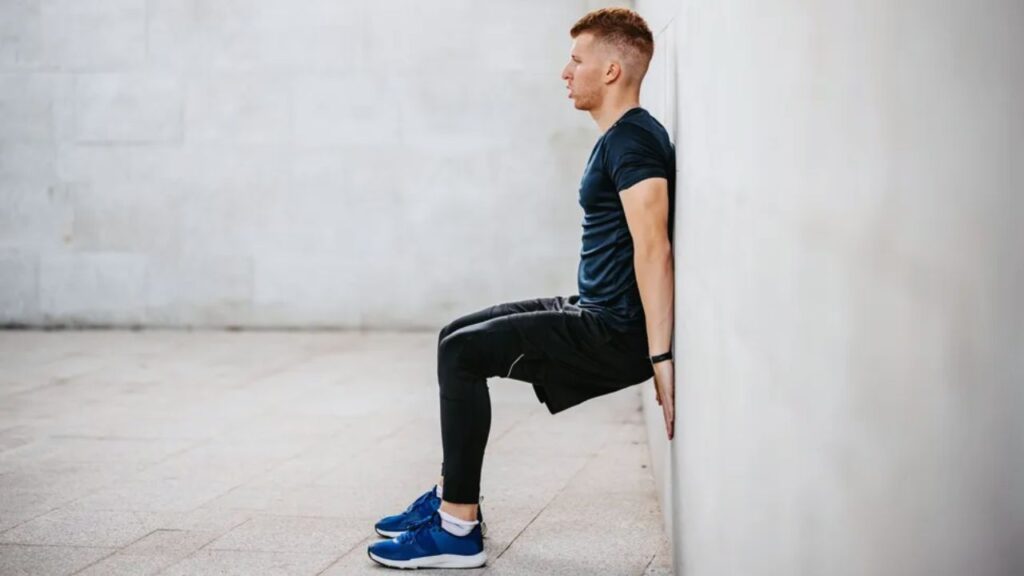
This exercise strengthens your lower body while improving mobility. Controlling the ball as you move also enhances thoracic mobility and overall muscle stability. By keeping your core engaged and staying upright throughout, you’ll get a full-body challenge that’s both effective and simple.
If you have a Pilates or Swiss ball, grab it now. Otherwise, a tennis ball or any similar-sized ball will work just fine.

Why This Exercise Works
The wall-ball prisoner squat activates your entire body, targeting your legs, glutes, and core. Placing your hands behind your head forces your upper body to work harder to stay upright, opening your chest and engaging your shoulder muscles. For those with limited mobility, this version is more challenging than a standard squat.

Adding the ball behind your back introduces an extra layer of focus. You’ll need to stabilize the ball between you and the wall, guiding it up and down your spine as you squat and rise. This enhances your mind-muscle connection, keeping you aware of both your movement and the ball’s position.
Benefits of the Wall-Ball Prisoner Squat
- Functional strength: Builds strength that translates to daily movements.
- Core engagement: Keeps your midsection active and supported.
- Improved mobility and stability: Encourages better posture and spinal alignment.
- Spinal massage: Gentle pressure along the back can relieve tension from sitting.
- Compound exercise: Works multiple muscles and joints simultaneously for efficiency, balance, and coordination.
Practicing this exercise daily for a few minutes gets your muscles moving and improves circulation, supporting joint health and posture. Because it combines multiple motions, it’s an effective way to maximize strength and stability in a short session.

How to Perform the Wall-Ball Prisoner Squat
Start with your arms by your sides, and only progress to placing your hands behind your head once you feel stable and confident.
- Stand with your back against a wall, feet about hip- or shoulder-width apart.
- Place the ball at your lower back, just above your glutes.
- Gently position your hands behind your head, drawing your shoulder blades together to open your chest.
- Engage your core and keep your chest upright as you bend your knees and lower into a squat, pressing your back lightly into the ball. Your feet stay in front, and your back remains parallel to the wall, moving vertically.
- Maintain control of the ball throughout. At the squat’s bottom, pause—the ball will now be at the top of your back.
- Drive back up to standing, guiding the ball carefully as you rise.
Repeat for a few minutes, rest, and complete 2–3 rounds. Alternatively, aim for 6–12 reps over 3–4 sets. Once comfortable, try lifting your heels and resting on the balls of your feet throughout the exercise to further engage your calves and quads, practicing the high-heeled squat variation.

It may seem simple, but this single daily exercise is a powerful way to improve strength, stability, and mobility all at once.
 A polar vortex disruption is on the way, and its magnitude is almost unheard of in February