
Late Sunday morning in a quiet suburb, the park bench looks like a generational battlefield. On one side, two teenagers hunched over their phones, thumbs tapping like mad. On the other, a gray?haired woman in a red windbreaker, sitting upright, a newspaper folded just so, a thermos of coffee at her feet. She looks around, watches the trees, smiles when a dog passes. The kids never look up.
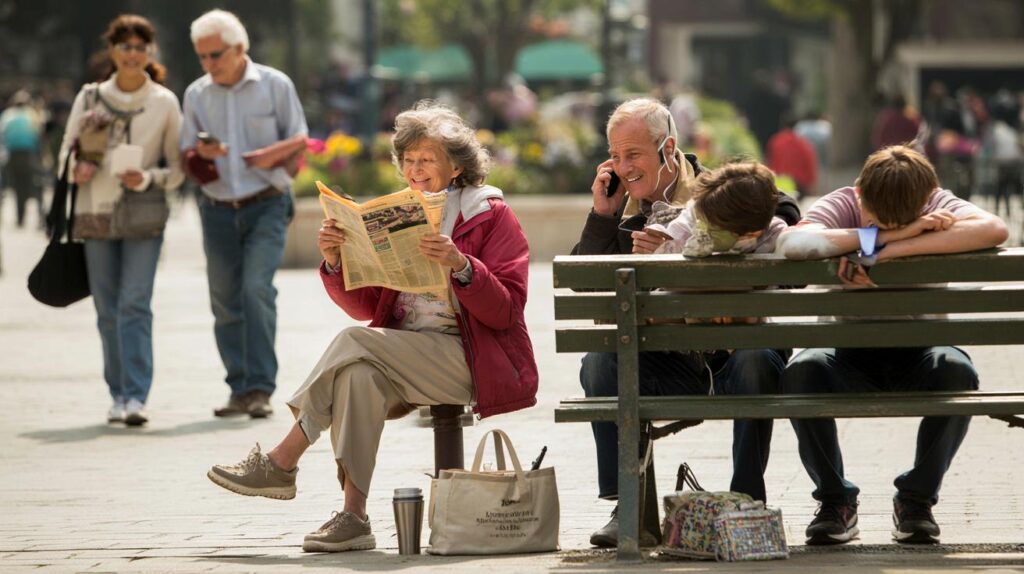
A small, almost invisible divide runs between them.
She seems slower, but strangely, she also seems…lighter.

1. Calling instead of texting — and actually listening
Ask anyone over 65 about “keeping in touch” and they won’t show you their latest WhatsApp trick. They’ll tell you who they called this week. For many of them, a phone is still a voice device, not just a notification machine.

They sit at the kitchen table, dial a number from memory, and let the conversation wander. Weather, health, the neighbor’s dog, an old memory that suddenly surfaces. There’s no rush. No pressure to be witty in three seconds flat. Just two humans, breathing in each other’s pauses.
A retired electrician in his early 70s told me he still calls his best friend every Wednesday at 5 p.m. It started when they were doing night shifts together in the 80s. Now, they live 600 kilometers apart, barely travel, but that call is non?negotiable.
“Sometimes we talk for ten minutes, sometimes for an hour,” he shrugged. “But when I hang up, I feel less alone.”
No blue ticks, no “seen 14:37” neurosis. Just the comfort of a voice that knows your past and still wants to hear your present.
There’s a reason this habit makes them calmer. The human brain reads tone, rhythm, little hesitations in a way that no emoji can replace. Voice conversation gives you instant emotional feedback: you hear the sigh, the laugh, the long silence before an honest answer.
Text makes us efficient. Voice makes us connected. Older people, who grew up with landlines and long?distance calls that cost money, treat conversation as something you give time to, not something you squeeze between two notifications.
2. Walking without earphones — and letting the world in
Watch a 70?year?old heading to the bakery. No earbuds. No tracking app loaded, no step goal flashing on the screen. Just a coat, a bag, maybe a hat if the wind bites. Their walk is not “cardio”, it’s simply how they move through their day.
They notice the chipped paint on the fence that wasn’t there last week. They nod to the crossing guard. They stop to pet the same cat that has ruled the same doorstep for twelve years. The world is not just a backdrop to their playlist. It is the playlist.
A woman in her late 60s told me she takes the same 20?minute walk every morning, around the block and past a small park. She doesn’t time it. She doesn’t measure her heart rate. She just walks.
One day she caught the smell of jasmine so strong she stopped in her tracks. Another day, she spotted a boy practicing skateboard tricks alone, and applauded when he finally nailed one. He grinned, surprised anyone had seen him.
“These tiny things,” she said, “they remind me I’m part of something that’s still alive.”
Researchers have a name for this: “soft fascination”. When your brain absorbs gentle, unpredictable details from your environment, it rests and resets at the same time. Birds, shop windows, the way light hits a puddle.
You don’t get that when your ears are sealed and your eyes glued to a screen counting calories. Older generations grew up walking as a default, not as a performance. That takes the pressure off. The walk doesn’t have to be impressive. It just has to exist.
*The world is already loud enough; not everyone needs a soundtrack on top of it.*
3. Reading paper — and escaping the infinite scroll
There’s a particular sound when a newspaper page turns. A soft crackle, a drag of the finger along the fold. People in their 60s and 70s often stay loyal to that sound. They still buy a physical newspaper or borrow books from the library, even while younger folks skim headlines on TikTok and never get to the third paragraph.
They sit in an armchair, phone face down on the coffee table, glasses halfway down their nose. The moment stretches. No pop?up. No auto?play. Just one story at a time, no algorithm jumping in to recommend “something you might also like before you’ve even liked the first thing.”
One retired nurse I met proudly showed me her library card, worn at the edges. She visits every Tuesday, a routine she started when her kids were small and money was tight. Back then, the library was free entertainment. Now, she says it’s “mental oxygen”.
She borrows three books: one novel, one biography, one “useful” book about gardening or cooking. She keeps them on her nightstand. When insomnia nudges her at 3 a.m., she opens a book instead of her phone. “If I go on my phone, it’s like falling into a hole,” she told me. “With a book, I can climb back out.”
Screens fragment attention. Paper bundles it back together. Older readers live with slower tech, so their patience grew in a different soil. They’re used to waiting a week for the next magazine issue. That rhythm reduces the constant pressure to *catch up* with everything, all the time.
Reading a paper book also has a clear beginning and end. Close the cover, and you’re done. No infinite scroll, no “You might also like” trap. For nervous, over?stimulated minds, that clear boundary is gold.
One simple truth sits under all this: **our brains were not built for endless feeds.**
4. Keeping rituals — coffee at 10, dinner at 7, no matter what’s trending
Ask a 70?year?old what they’re doing at 10 a.m. on a weekday and you’ll often get the same answer every time. Coffee. Crosswords. Maybe a radio show they’ve followed since the 90s. Rituals hold their days together like invisible stitching.
There is comfort in knowing that, come rain or news alert, the mid?morning coffee will still happen. No doomscrolling before the first sip. No Zoom call sneaking into the sacred slot. Just the small ceremony of boiling water, stirring sugar, folding the newspaper to the exact right column.

I met a couple in their early 70s who still eat dinner at the table at 7 p.m. sharp. No TV. No phones in sight. The habit started when their kids were young. When the kids left, the parents kept the ritual for themselves.
They set out placemats, light a tiny candle in winter, and talk about the day, even if “the day” was just a trip to the pharmacy and a call from a cousin. On nights when they argue, they still sit down at 7. The ritual doesn’t fix everything, but it keeps the thread unbroken.
Modern life worships flexibility. Change your plans instantly, reschedule with one tap, eat whenever you’re “free”. Older generations grew up in a world where buses left at 8:02 and shops closed at 6 sharp. That bred a quiet respect for regularity.
Routine lowers anxiety because it removes a thousand micro?decisions. Eat now or later? Scroll or chat? Cook or order? For many people in their 60s and 70s, the decision is already made by the habit. Energy that would be burned on choosing is freed up for living.
“Rituals are the structure that holds us when we don’t quite know how to hold ourselves,” a 69?year?old widower told me softly, hands wrapped around his chipped mug.
- Morning drink at the same hour
- Daily walk on a familiar route
- One regular call with a friend or sibling
- Shared meals at the table, not the couch
- Weekly “anchor” activity: market, library, church, club
5. Talking to strangers — and belonging to a place
If you’ve ever watched an older person at a bus stop, you’ve seen it. Two lines about the weather, a comment about the bus being late, and suddenly they’re telling each other about grandkids or knees or the price of potatoes. For many people over 60, small talk is not awkward. It’s survival.
They grew up when neighborhoods were actual communities, not just shared postcodes. Doors stood open. People borrowed sugar. You knew who lived above, below, across. That habit of light, easy contact didn’t disappear just because smartphones arrived.
A man in his mid?60s told me he deliberately sits on the same bench in the same square every afternoon around 4. At first, nobody noticed. After a month, a dog started trotting over for a scratch. After three, another regular sat beside him sometimes.
Now, there’s an unspoken “bench club”: three retirees, one delivery guy on break, a young mom with a stroller. They don’t exchange phone numbers. They just talk, complain, laugh, and then drift back into their lives. “I don’t need more friends online,” he said. “I need these five?minute humans.”
Digital life makes it easy to filter out strangers. You follow who you like, mute who annoys you, and build a tight bubble of people who think the way you think. It feels safe, but it also shrinks your world.
Older people who still chat in line at the bakery get tiny doses of novelty every day. A new opinion. A different accent. A recipe tip. These micro?connections don’t go on a follower list, yet they feed the same hunger: to feel seen.
**Many tech?obsessed young people have global contacts but no local warmth.**
6. Doing one thing at a time — and letting boredom breathe
Watch someone in their 70s peel potatoes. It’s almost radical. They sit, knife in hand, bowl in lap. No podcast in their ears, no show in the background, no “productive multitasking”. Just peel, turn, peel, drop. The rhythm is slow but steady.
They don’t label it mindfulness. To them, it’s just…life. One thing after the other. Cook, then eat, then wash up. Not answer emails while stirring sauce. Not message three people while halfway listening to a video. There’s a groundedness in that linear way of moving through the day.
A 72?year?old former secretary laughed when I asked if she multitasks. “I spent forty years answering phones, typing letters, and filing at the same time,” she said. “I’ve done my share. Now I like to give things my full attention, one by one.”
She knits in the evening while the radio murmurs. When she feels restless, she doesn’t open ten tabs. She waters her plants. If nothing needs doing, she sits on the balcony and simply…sits. “Sometimes I get bored,” she admitted. “Then an idea arrives.”
Younger generations are told that boredom is a problem to be solved instantly. Tap, scroll, refresh. The slightest empty second must be filled. Problem is, creativity and emotional digestion happen in those empty seconds.
Older folks who are comfortable doing just one thing at a time end up giving their brain actual pauses. Those pauses often feel like peace. Sometimes they feel like sadness, too, but at least there is room for it to pass through.
There’s a quiet courage in not fleeing every dull moment with a screen.
What their “old habits” are really telling us
When you zoom out, these old?school habits look almost suspiciously simple. Call someone. Walk without headphones. Read paper. Keep rituals. Talk to strangers. Do one thing at a time. None of it would impress a productivity guru.
Yet again and again, when you sit with people in their 60s and 70s and really listen, these are the things they say protect their mood. Not the newest app. Not the latest phone. A handful of quiet, repeated gestures that anchor their days to something deeper than the next notification.
We’ve all been there, that moment when you look up from your screen and wonder where the last hour went, or why you feel strangely empty after “connecting” with dozens of people online. The elders in our lives are not necessarily wiser in every domain. But they’ve lived long enough to see what stays and what fades.
Their habits survived precisely because they deliver something no device can quite replicate: the slow, stubborn feeling of belonging to your own life.

Maybe the real question isn’t why they won’t drop these habits. It’s what we might gain if we quietly picked a few of them back up.
 The forgotten kitchen liquid that effortlessly turns grimy cabinets smooth, clean, and shiny again
| Key point | Detail | Value for the reader |
|---|---|---|
| Voice over text | Regular phone calls, fewer but deeper conversations | Stronger connections, less anxiety over messages |
| Rituals and routines | Fixed times for coffee, meals, walks, library visits | Lower stress, more stability and emotional safety |
| Single?task living | Doing one thing at a time, accepting boredom | Clearer mind, more creativity, calmer nervous system |
FAQ:
- Why do older people seem happier with less technology?They often use tech as a tool instead of a lifestyle. Their days are still built around human rhythms — calls, walks, routines — so their happiness isn’t tied to notifications or online validation.
- Can younger people really adopt these habits without “falling behind”?Yes. You don’t need to abandon tech, just set small protected pockets of old?school living: one phone call a week, one walk without headphones, one tech?free meal per day.
- Isn’t this just nostalgia for the past?Some of it is colored by memory, of course, but many of these habits are backed by current research on attention, mental health, and social connection. Old doesn’t automatically mean outdated.
- What’s the easiest habit to start with?Most people find a daily walk without their phone in hand the simplest. Just 15–20 minutes of looking around instead of looking down already changes how the rest of the day feels.
- How do I keep these habits when my job is very online?Think of them as anchors, not rules. Even with a screen?heavy job, you can anchor your day with offline rituals before and after work, and keep at least one meaningful voice conversation each week.
