
A wooden spoon. A leather shoe. A section of hull that still holds the curve of a shipwright’s hand from 250 years ago. On the support boat, nobody speaks for a moment. The objects seem too alive for their age, as if the people who used them have just stepped away for a minute.
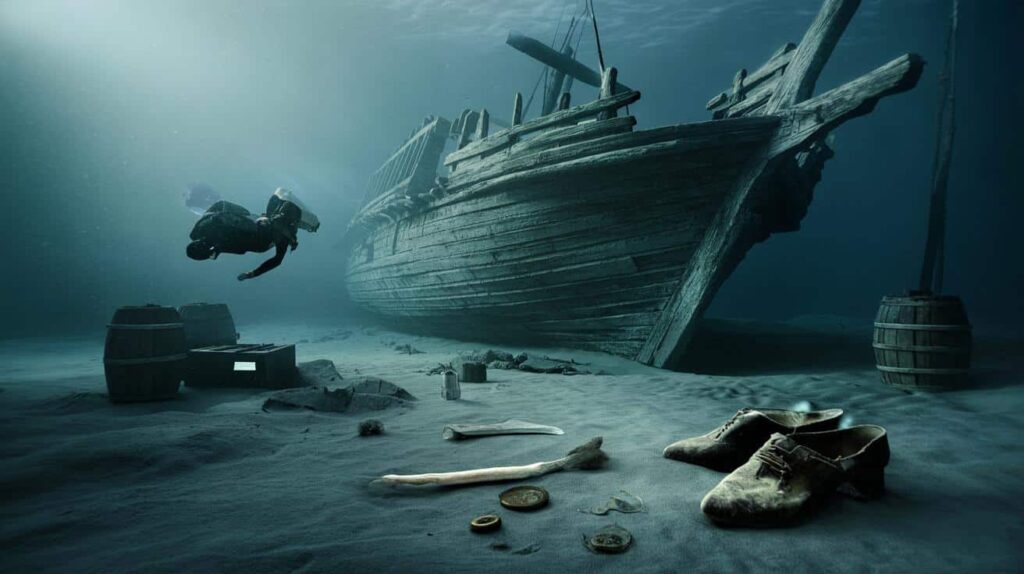
The wreck beneath them once carried grain, people and gossip across Europe. Now it’s a time capsule, sealed by water that rarely climbs above fridge temperature. No tropical turquoise here, just darkness, silt and a chill that bites through neoprene.
Down there, history doesn’t fade. It waits.

A frozen archive on the seabed
The first time you see a cold-water wreck on camera, it’s almost unsettling. The timbers look solid. The rigging still snakes along the deck. In some Baltic sites, the paint on carved figureheads clings on, stubborn as old stories.

The colours are muted, but the shapes are clear. Barrels sit upright. Plates lie where a galley table once stood. The ship is broken, yes, yet bizarrely intact, like a house abandoned yesterday and dusted in silt instead of cobwebs.
Cold water doesn’t just hide these ships. It holds them.
One of the clearest examples comes from the Baltic Sea, often called an underwater museum. In 2023, archaeologists announced the discovery of an 18th‑century merchant ship there, its hull almost completely preserved. Brass buttons, glass bottles, even parts of the cargo lay in place, like props on a stage left mid‑performance.
They compared it to wrecks in warmer waters discovered from the same era. Same century, same basic technology. Totally different fate. In the Mediterranean, timbers had turned to soft, worm‑chewed ghosts of wood. Leather shrank and broke apart once touched. In the Caribbean, storms and hungry organisms devoured hulls until only a scatter of ballast stones remained.
The cold Baltic wreck, by contrast, looked ready to be refloated. It wasn’t magic. It was temperature.
The logic is blunt and a little brutal. Warmth speeds things up. Bacteria breed faster. Wood‑boring worms thrive. Metal corrodes at an aggressive pace. Every degree up the scale is a small push towards decay. In cold seas, that urgency simply isn’t there.
At low temperatures, the enzymes that break down organic material slow right down. The notorious ship‑eating mollusc Teredo navalis struggles in brackish, near‑freezing conditions. Fewer storms reach deep water in these latitudes, so hulls aren’t constantly rolled and shattered by waves.
Cold water is not kind. Yet for dead ships and lost cargo, it is strangely gentle.
Why cold beats warm in the race against decay
Think of a shipwreck as a buffet laid out on the seabed. In tropical seas, that buffet is open 24/7. Bacteria, fungi, worms, crabs, chemical reactions – everything lines up for a piece. The water is warm, the oxygen flows, the metabolism of every living thing around is on fast‑forward.
Those iconic Caribbean blues hide a ruthless efficiency. Wooden beams are shot through by worms. Iron blooms into flaky rust, reaching deep into the metal like roots. Cloth vanishes. Humans love to dive there because it looks inviting. For archaeology, it’s a short, noisy party that ends in silence and scraps.
In cold water, the buffet is half‑closed. The guests move slowly. Some never arrive at all.
Look at the wreck of HMS Erebus and HMS Terror in the Canadian Arctic. These ships vanished in the 1840s with Franklin’s doomed expedition, frozen into myth along with the sea that swallowed them. When teams finally reached them, they found glass intact in cabin windows. Plates stacked. Shoes. Personal items that tell you exactly how someone lived, and maybe how they died.
The Arctic water around them hovers near freezing most of the year. Sunlight barely reaches the seabed. Microorganisms are present, but their activity is sluggish. So the ships linger in a kind of slow time, degrading, yes, but on a scale that works for historians rather than worms.
Even in less extreme settings – say, Scottish lochs or deep Nordic fjords – the story repeats itself. Cooler, darker, quieter water keeps wrecks legible where warmer seas turn them into puzzles missing most of the pieces.
Peel back the emotion of it and the science is straightforward. Decay is chemistry and biology. Both are driven by energy. Warm water means more energy. More collisions between molecules. Faster growth of the organisms that eat wood, bone, fabric and leather.
Drop that temperature and reactions crawl. Bacterial growth slows. Some species vanish from the equation entirely. Oxygen levels can fall in deep or enclosed cold waters, choking off another driver of corrosion. Metals still react, but at a pace that stretches decades into centuries.
That’s why a 250‑year‑old hull in the Baltic can still hold its shape, while a much younger ship in a shallow, warm bay might have already dissolved into memory. Cold seas turn wrecks into archives, not just curiosities.

How explorers and museums keep the time capsules intact
Once a cold‑water wreck is found, the real challenge begins: touching as little as possible while learning as much as possible. The first method is almost disappointingly gentle. Divers hover, not kneel. They fan away silt with a hand instead of a tool. Cameras do most of the work, gliding along the deck on robotic arms or small ROVs.
The rule is simple: the wreck has survived centuries without us. Our job is not to ruin that streak in an afternoon.
Back on the surface, specialists use those images to create detailed 3D models. No need to pry every object out of the mud. You can walk the deck virtually, measure timbers, study carvings, and even “lift” objects with a mouse click rather than a crane.
There’s a harsh truth many conservators admit quietly. Lifting an artefact from cold water is often the moment it starts to die. A wooden plate that has soaked in brackish water for 200 years looks solid when you pull it up. Expose it to air and it can warp, split, crumble. Salt crystals expand. Fungi move in.
So the best teams move slowly. They keep objects wet, sometimes for years, in carefully controlled baths. They replace water in the wood with stabilising chemicals. It’s tedious work, closer to plant care than treasure hunting. Soyons honnêtes : nobody dreams of archaeology as endless tanks and spreadsheets.
Yet that patience is what keeps a sailor’s shoe, or a hand‑carved spoon, from turning to dust between one exhibition and the next.
“The sea protects our history, and we are the ones who can break that protection in a single season,” one Baltic conservator told me. *“So we try to touch as lightly as the water does.”*
That line sits on a whiteboard in his lab, right next to a practical checklist that sounds almost mundane:
- Limit the number of divers on a fragile wreck at any one time.
- Use lights sparingly to avoid heating and stressing delicate surfaces.
- Raise only what you can properly conserve, store and study.
- Document objects in situ before moving a single grain of sand.
- Plan for decades, not months, when starting a conservation project.
On a human level, these rules protect something less tangible too. Cold‑water wrecks often still feel inhabited. Letters lie folded. Tools rest beside tasks never finished. Rushing in with winches and headlines risks shredding that connection. The best teams walk a thin line between curiosity and restraint, knowing they can’t have everything.
What these frozen ships say about our future
Cold water has been a quiet ally for historians for centuries, locking ships and stories in a deep, slow archive. That archive isn’t untouchable. Rising sea temperatures, changing salinity, more storms – all of that shifts the balance in favour of the organisms and reactions that eat away at wrecks.
Some Baltic sites already show early signs of shipworm creeping into areas where it never thrived before. The same processes that threaten coral reefs and fishing grounds can also wake up long‑dormant decay on a 250‑year‑old hull.
There’s a strange symmetry here. The same global changes driven by our fossil‑fuel age may accelerate the destruction of the very wooden ships that carried that first coal, that first oil machinery, across the oceans.
Cold water won’t vanish overnight. Deep, dark places will still cradle intact relics for generations. Yet the idea that these wrecks can wait for us indefinitely is quietly fading. Archaeologists now speak of “rescue archaeology” for some underwater sites, racing to document and preserve before conditions flip from protective to hostile.
On a more personal level, these ships nudge at a discomfort many of us feel. We live in a culture obsessed with speed, updates, the next notification. Then you see a spoon, a shoe, a carved name surviving beneath the waves for 250 years, and you realise how rarely we think beyond our own timeline.
On a good day, that realisation isn’t depressing. It’s grounding. Someone nailed that plank into place in 1770‑something, cursing the cold or humming a song. They had arguments, private jokes, unpaid bills. They worried about storms in the same way we worry about emails. On a bad day, maybe they also felt that sense of being a little lost that modern life just dresses up with better tech.
Cold water preserves more than objects. It preserves proof that people before us were just as messy, hopeful and scared. We don’t get their voices. We get their plates and boots instead. That’s less than we’d like, and still more than enough to feel a jolt of recognition.
Anyone who dives or even just stares out at a grey, northern sea knows that pull. The knowledge that under that flat, icy surface, whole stories are waiting. Not to be rescued perfectly – that fantasy never survives first contact with reality – but to be noticed, listened to, and, in some quiet way, respected.

In the end, the real question isn’t just why cold water preserves history better than warm seas. It’s what we choose to do with the stories that cold has kept safe for us, long after their owners stopped breathing.
 A centenarian reveals the daily habits behind her long life, saying “I refuse to end up in care”
| Point clé | Détail | Intérêt pour le lecteur |
|---|---|---|
| Cold water slows decay | Low temperatures reduce biological activity and chemical reactions | Helps you understand why some wrecks look almost “frozen in time” |
| Certain seas act as natural museums | Baltic, Arctic and deep northern waters preserve ships, cargo and personal items | Offers real‑world examples that make the science tangible and memorable |
| Human choices can protect or destroy | Diving practices, conservation methods and climate change all shape a wreck’s future | Shows how present‑day actions decide which stories survive for the next generation |
FAQ :
- Why does cold water preserve shipwrecks so well?Because low temperatures slow down bacteria, fungi and chemical reactions, and in some regions limit wood‑boring organisms like shipworm, so wood, leather and fabrics decay far more slowly.
- Are all cold seas good at preserving wrecks?No. Preservation also depends on depth, oxygen levels, salinity and how exposed the site is to storms or currents, so some cold‑water wrecks still deteriorate quickly.
- Do archaeologists always raise artefacts from cold‑water wrecks?Not always. Many prefer to document sites in place with photos, videos and 3D scans, and only lift objects they can properly conserve over the long term.
- Can climate change damage these well‑preserved wrecks?Yes. Warmer waters and shifting salinity can allow new organisms, like shipworm, to invade previously safe areas and speed up the destruction of wooden hulls.
- Can ordinary divers visit cold‑water wreck time capsules?Some accessible sites are open to trained divers, but many are protected, deep or hazardous, so most people explore them through documentaries, virtual tours and museum exhibitions.
